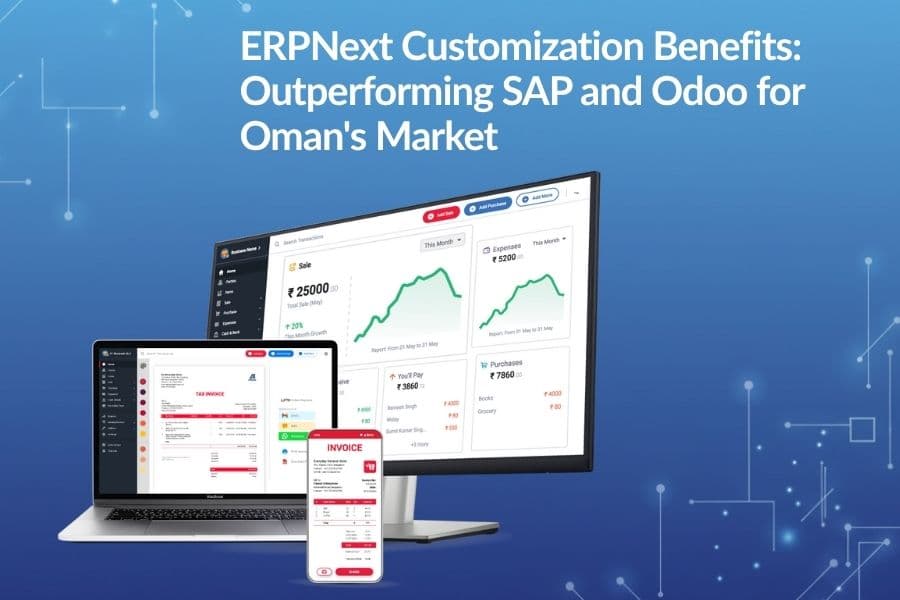
ERPNext Customization Benefits: Outperforming SAP and Odoo for Oman’s Market
In Oman’s rapidly transforming business landscape, choosing the right ERP software is no longer just about automation — it’s about adaptability. ERPNext Oman has gained immense popularity among businesses that seek flexible, affordable, and future-ready ERP systems. Unlike SAP and Odoo, ERPNext offers unmatched customization capabilities, allowing Omani enterprises to tailor every module to fit their operational needs, compliance standards, and growth goals.
This blog explores why ERPNext’s customization flexibility outperforms SAP and Odoo for Oman’s market and how it’s becoming the go-to ERP platform for modern businesses in the Sultanate.
Understanding ERPNext’s Open-Source Advantage
One of the biggest differentiators between ERPNext and legacy systems like SAP and Odoo is its open-source foundation. This architecture gives businesses in Oman complete ownership over their ERP system. You’re not bound by vendor restrictions or annual licensing fees — meaning you can customize, scale, and innovate without limitations.
Unlike Odoo, where additional modules or updates often come at a cost, ERPNext allows organizations to modify workflows, integrate new features, and adjust interfaces freely. This flexibility is particularly valuable for industries like construction, manufacturing, and trading that require dynamic, evolving business processes.
Localization for the Omani Market
ERPNext’s adaptability extends beyond technical customization — it also supports localization. Omani businesses benefit from modules configured for VAT compliance, bilingual support (English and Arabic), and region-specific accounting standards. This localized approach ensures ERPNext aligns seamlessly with Oman’s commercial environment.
GazelleTech Oman, a trusted technology provider, highlights that ERPNext’s customization tools empower businesses to localize operations efficiently while maintaining data accuracy and compliance with Omani regulations. This gives ERPNext a clear edge over SAP and Odoo, which often require expensive localization plugins or external integrations.
Tailored Workflows That Fit Every Industry
Every business in Oman operates differently — what works for a construction firm may not suit a retail or logistics company. ERPNext recognizes this diversity by offering modular customization. From HR policies and project management to warehouse operations and invoicing, every process can be adjusted to reflect a company’s internal structure.
For example:
- Manufacturers can customize production tracking and quality control modules.
- Retailers can integrate POS and inventory analytics.
- Service providers can automate billing, CRM, and employee performance reports.
In comparison, SAP’s rigid architecture often demands external consultants to achieve similar results — leading to higher costs and longer deployment times.
Faster Implementation and Lower Costs
ERPNext’s flexibility doesn’t just simplify customization — it accelerates implementation. Businesses in Oman can deploy a fully functional ERP system in weeks rather than months. Because it’s open-source, ERPNext avoids the licensing and per-user fees that make SAP and Odoo expensive.
This affordability makes ERPNext especially appealing to SMEs and startups that want to scale efficiently. Many Omani companies report up to 40% savings in total implementation costs when choosing ERPNext over SAP or Odoo.
The intuitive interface also means teams require minimal training. Employees can quickly adapt to the system, boosting productivity and reducing dependency on external support teams.
Integration with Existing Systems
ERPNext integrates easily with other business applications such as eCommerce platforms, cloud storage, and accounting tools. This flexibility allows Omani companies to connect existing software with ERPNext without disrupting current workflows. For example, integrating with payment gateways, HR systems, or data analytics tools can be done seamlessly — saving time and reducing manual effort.
By contrast, SAP and Odoo users often face compatibility challenges, requiring middleware or costly customization to achieve the same result.
Empowering Digital Transformation in Oman
As Oman accelerates toward its Vision 2040 digital goals, companies are prioritizing agility and efficiency. ERPNext plays a crucial role in this transformation journey. Its open architecture encourages innovation by allowing developers and businesses to build new modules or connect advanced technologies like AI and IoT.
With ERPNext, Omani organizations are not just automating processes — they’re gaining insights, improving collaboration, and driving sustainable growth. This future-ready approach aligns perfectly with the nation’s ambition to create a competitive, knowledge-based economy.
Why Omani Businesses Prefer ERPNext Over SAP and Odoo
Let’s summarize the key reasons ERPNext is outperforming SAP and Odoo in Oman:
- Open-source freedom — no vendor lock-ins or annual fees.
- Faster customization — tailor modules without complex coding.
- Localized support — Arabic language, VAT modules, and regional compliance.
- Lower cost of ownership — ideal for SMEs and large enterprises alike.
- User-friendly interface — minimal training, faster adoption.
- Scalable and future-ready — built for Oman Vision 2040.
Conclusion
ERPNext’s customization benefits make it the most adaptable ERP solution for Oman’s evolving market. With its open-source flexibility, localized features, and affordability, it gives Omani businesses the tools they need to thrive in a competitive landscape.
As GazelleTech Oman continues to deliver cutting-edge ERPNext implementation services, more companies across the Sultanate are realizing that customization isn’t just an option — it’s the foundation for long-term digital success.
ERPNext Oman isn’t just keeping up with global ERP systems like SAP and Odoo — it’s redefining what ERP means for the modern Omani enterprise.