Top ERP Software Trends in Oman 2026: Cloud ERP, ERPNext, and SME Growth
Anonymous
Executive Summary
Oman’s Vision 2040 digital agenda is accelerating ERP adoption among SMEs in Muscat, Salalah, Sohar and beyond. Cloud-based ERP and open-source platforms like ERPNext offer cost-effective, scalable tools to unify finance, inventory, HR, CRM and more. Key 2026 trends include moving to cloud ERP, leveraging AI and mobile access, and choosing industry-specific solutions. This report compares cloud vs on-premise ERP, ERPNext vs traditional ERPs, and provides implementation tips and ROI guidance for Omani businesses.
Oman’s Digital Growth and ERP Demand
Oman’s national strategy (Vision 2040) encourages private sector innovation and digital transformation. Businesses from Muscat to Salalah are adopting modern ERP systems to meet these goals. Local ERP providers (e.g. OmanERP at omanerp.com) emphasize integrated cloud ERP to streamline operations and replace spreadsheets. For example, a unified ERP can handle accounting, sales, inventory, and payroll in one platform.
Leading companies in manufacturing, logistics and retail are already reaping benefits. In Sohar’s industrial zone, firms use ERP to optimize supply chains, while Salalah trading companies use ERPNext for multi-warehouse operations. These success stories show that ERP software in Oman delivers real-time data, cost savings, and regulatory compliance – vital for Vision 2040 objectives.
Key ERP Trends in 2026
- Cloud Migration Accelerates – Omani companies are rapidly moving to cloud ERP. Cloud solutions lower IT costs, provide automatic updates, and let teams access data anywhere. Industry reports show cloud ERP adoption is growing fast, driven by SMEs needing flexible, scalable systems.
- AI and Analytics – ERP systems now use AI for predictive planning and automated reporting. This helps Omani businesses spot trends and manage inventory more accurately. SMEs are integrating AI-driven dashboards to forecast demand and improve decision-making.
- Mobile & Remote Access – Modern ERP has mobile apps and browser access, letting managers in Muscat or field staff in Salalah review dashboards on the go. This mobility boosts productivity in retail, healthcare, and services, as real-time ERP data is available outside the office.
- Sustainability Metrics – ERP platforms are adding environmental tracking tools. Companies can monitor energy use and waste, aligning with Oman’s sustainability goals. This trend helps industries like manufacturing and logistics manage resources more responsibly.
- Industry-Specific Modules – More ERP offerings will be tailored to Omani sectors. For instance, hotels in Muscat may get tourism-specific CRM, and fishermen in Dhofar may use inventory tracking suited for perishable goods. Industry-focused ERP ensures SMEs get relevant features out-of-the-box.
- Cybersecurity & Compliance – With digitization, ERP security is paramount. Modern ERP systems include strong access controls, data encryption, and audit trails to meet Oman’s regulatory standards. These features protect sensitive financial and HR data in the cloud.
Below is a comparison of Cloud vs On-Premise ERP solutions relevant for Oman’s market:
| Aspect | Cloud ERP | On-Premises ERP |
|---|---|---|
| Upfront Cost | Lower initial spend (subscription model) | Higher (servers, licenses) |
| Scalability | Easily scales up or down | Scaling requires new hardware/software |
| Deployment Time | Faster (weeks) | Longer (months) |
| Maintenance | Handled by vendor (updates, backup) | Handled in-house |
| Accessibility | Anywhere access via internet | Access from office network |
| Security | Enterprise-grade cloud security | Depends on internal setup |
| Customization | Configurable via modules | Deep customization (costly & complex) |
This table highlights why Oman’s SMEs prefer cloud ERP for flexibility and cost savings. Government initiatives (eOman) and SME support policies are further driving this shift.
ERPNext vs Proprietary ERP (SAP/Odoo)
In Oman, ERPNext is emerging as a top choice for SMBs. Its open-source model cuts license fees, allowing budgets to focus on training and data migration. ERPNext supports Arabic language and Omani tax rules natively, making deployment smoother. In contrast, proprietary ERPs like SAP or Odoo often involve high costs and complex setups.
| Feature | ERPNext (Open-Source) | Proprietary ERP (SAP/Odoo) |
|---|---|---|
| License Cost | Free core (no recurring fees) | High yearly fees |
| Customization | Flexible; easily add local features | Custom work often costly |
| Ease of Use | Intuitive interface; quick onboarding | Can be complex (SAP) |
| Support | Global community + local partners (OmanERP) | Vendor support (may lack local focus) |
| Cloud/Deployment | Cloud or on-prem options | Often fixed model; Odoo cloud, SAP on-prem |
| Modules Included | Comprehensive (Finance, HR, CRM, Mfg, POS, etc.) | Comprehensive but may need add-ons |
Omani companies report measurable gains with ERPNext. For example, a Muscat trading firm cut inventory costs by 20% using ERPNext’s stock analytics, and a Sohar manufacturer improved efficiency by 30% through ERP automation. These success stories underscore ERPNext’s practicality for local businesses.
Recommendations for Omani SMEs
- Assess Needs & ROI: List your pain points and quantify benefits. ERP can reduce manual tasks (studies show 30–40% admin savings) and speed up reporting.
- Choose the Right Partner: Work with local ERP experts who know Oman’s regulations and languages. For example, OmanERP specializes in tailoring ERPNext for Omani firms.
- Pilot First: Start ERP in one department (e.g., finance or inventory) before rolling out company-wide. This helps fine-tune processes with less risk.
- Train Users: Invest in employee training. ERPNext’s clean design usually means faster user adoption, but training ensures staff leverage all features.
- Prefer Cloud ERP: Unless you have strong IT infrastructure, pick a cloud-hosted ERP. It lowers IT overhead and supports remote work.
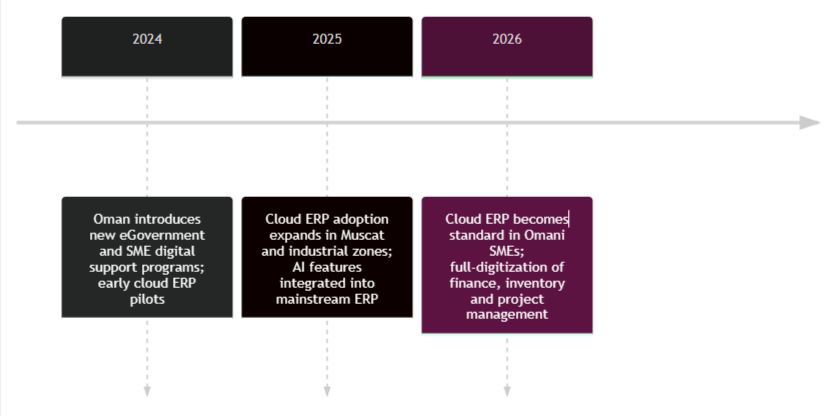
ERP Adoption Timeline (2024-2026)
Practical Features to Look For
- Finance & Accounting: VAT/GST compliance, multi-currency, financial reporting.
- Inventory & Supply Chain: Real-time stock tracking, reorder automation, multiple warehouses (e.g., Salalah, Sohar).
- HR & Payroll: Oman payroll rules, leave management, labor law compliance.
- CRM & Sales: Lead tracking, quotations, and post-sales support.
- Business Intelligence: Dashboards and KPI analytics for real-time insights.
Modules listed on the OmanERP site (finance, procurement, sales, etc.) exemplify these features. Ensure the ERP covers all critical functions, either natively or via integrations.
Conclusion
By 2026, ERP adoption will be widespread among Oman’s SMEs. ERP software in Oman – especially cloud-based ERPNext solutions – offers a path to streamline operations and achieve Vision 2040’s objectives. Embracing these trends with careful planning and local expertise means Omani businesses can compete more effectively and drive sustainable growth. Adopting the right ERP system is an investment in efficiency and growth. Leveraging the latest ERP trends and partnering with knowledgeable providers (such as omanerp.com) will help Oman’s SMEs unlock productivity, improve profitability, and thrive in the digital era.