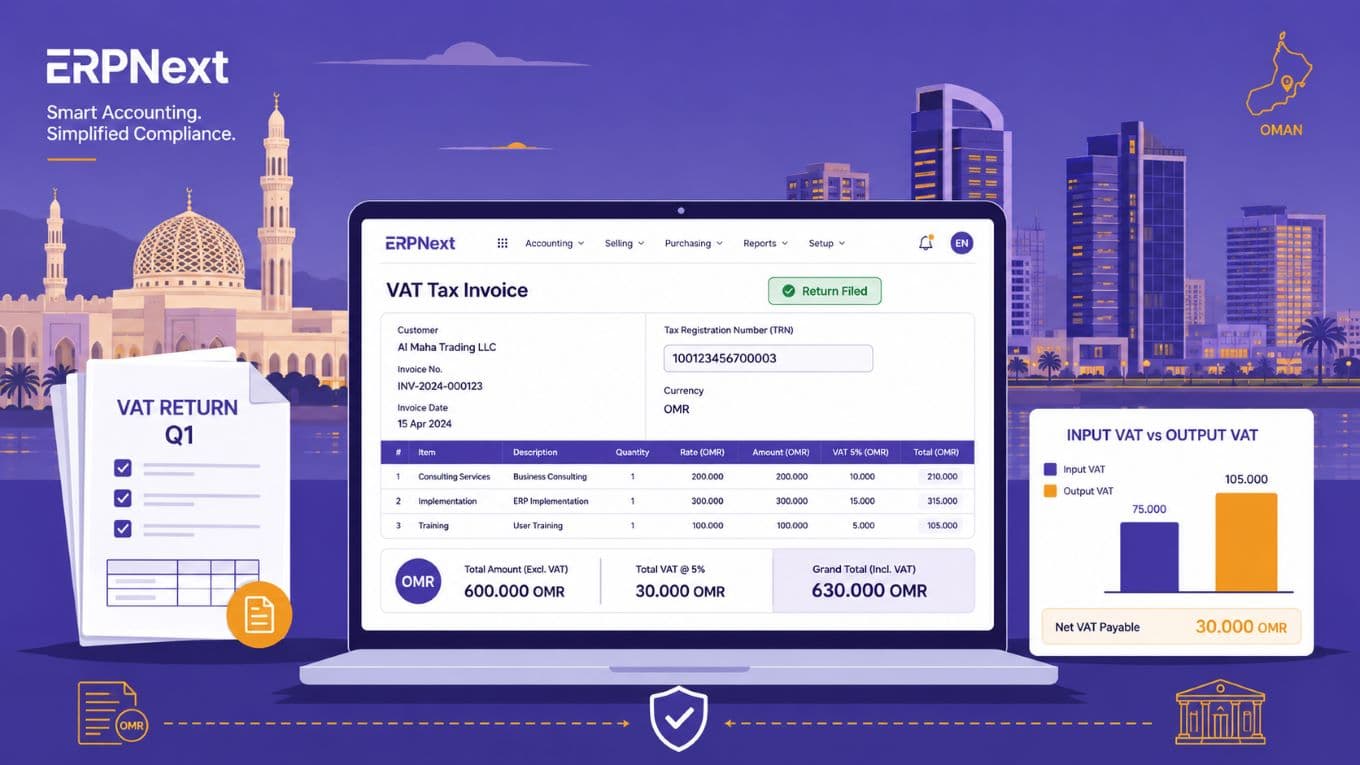
How ERPNext Helps Omani SMEs Master VAT and Tax Compliance
Anonymous
ERPNext VAT compliance in Oman is reshaping how small and medium enterprises across the Sultanate manage their tax obligations. Since Oman’s 5% VAT came into force in April 2021, thousands of SMEs in Muscat, Sohar, Nizwa, and Salalah have struggled to keep up with invoicing rules, return deadlines, and audit requirements. Many businesses still rely on spreadsheets or outdated accounting tools that were never designed for Oman’s evolving regulatory environment.
ERPNext provides a proven, affordable, and fully localised solution that helps businesses reduce compliance risks while streamlining financial operations. This guide explains how ERPNext supports VAT compliance for Omani SMEs.
Understanding VAT Obligations for Omani SMEs
The Oman Tax Authority (OTA) requires all VAT-registered businesses to:
- Issue compliant tax invoices
- Maintain accurate input and output tax records
- Submit periodic VAT returns, usually on a quarterly basis for SMEs
Penalties for errors, delayed filings, or incomplete records can reach up to OMR 5,000 per violation. For small businesses operating on tight margins, even a single audit issue can have a significant financial impact.
The challenge is not only understanding the rules but also implementing systems that apply them consistently across every sale, purchase, and expense transaction. ERPNext helps close this compliance gap with automation and structured workflows.
How ERPNext Handles VAT Compliance in Oman
1. Compliant Tax Invoice Generation
Every sales invoice created in ERPNext automatically applies the configured Oman VAT 5% tax template. Each invoice displays:
- Tax Registration Number (TRN)
- Taxable amount
- VAT amount
- Total amount in Omani Rial (OMR)
These are all mandatory fields required by the OTA. Whether a business generates 10 invoices or 10,000 invoices per month, ERPNext maintains a consistent and compliant invoice format.
2. Input VAT Tracking and Credit Reconciliation
One of the major advantages of VAT registration is the ability to recover input tax on purchases. ERPNext records VAT paid on supplier invoices and automatically offsets it against output tax liability.
At the end of the filing period, the net VAT payable amount is calculated automatically, significantly reducing manual reconciliation work for finance teams.
3. VAT Return Reports for OTA Submission
ERPNext includes a dedicated VAT Return report aligned with the OTA reporting structure. Finance teams can:
- Navigate to Accounts → VAT Return
- Select the required filing period
- Review the VAT summary
- Export the report for submission
This process removes the need for manual re-entry and minimises reporting errors.
4. Multi-Tax Category Support
Not all products and services in Oman are subject to the standard 5% VAT rate. Certain goods and services may fall under:
- Standard-rated
- Zero-rated
- Exempt categories
ERPNext supports all VAT categories on a line-by-line basis within the same invoice, making it ideal for trading companies, retailers, and businesses with mixed supplies.
Setting Up ERPNext VAT Compliance in Oman
Most Omani SMEs can complete their ERPNext VAT configuration within a single working day.
Setup Checklist
- Go to Accounts → Tax Templates and create:
- Oman Output VAT 5%
- Oman Input VAT 5%
- Add your Tax Registration Number (TRN) under:
Company Settings → Tax ID - Assign VAT templates to:
- Sales Invoice item tax defaults
- Purchase Invoice item tax defaults
- Set the VAT filing frequency in Fiscal Year settings.
Quarterly filing is standard for most SMEs. - Run a test invoice and verify:
- VAT calculations
- TRN visibility
- OMR totals
- Schedule quarterly reminders to generate and review VAT Return reports before the OTA filing deadline.
For a complete walkthrough covering chart of accounts, WPS payroll, and multi-branch setup, refer to the ERP implementation guide for Omani businesses.
Common ERPNext VAT Compliance Mistakes to Avoid
Using the Wrong Currency
Always lock the company currency to OMR before going live. Mixed-currency invoicing can lead to VAT calculation inconsistencies.
Missing Supplier TRNs
Supplier Tax Registration Numbers should always be included on purchase invoices. Missing TRNs may invalidate input VAT claims and increase audit risks.
Incorrect Tax Mapping
Avoid assigning all items as standard-rated by default. Configure zero-rated and exempt items correctly in the Item Master before issuing invoices.
Skipping Period-End Reconciliation
Run the VAT Return report before every filing period ends to identify discrepancies early and correct them before submission.
ERPNext VAT Compliance Oman vs Manual Bookkeeping
A typical Omani SME processing around 200 invoices per month may spend 12 to 15 hours every quarter on manual VAT bookkeeping, reconciliation, and return preparation.
ERPNext can reduce this workload to less than two hours while significantly lowering the risk of human error. Every transaction is timestamped, linked to its source document, and easily retrievable during audits.
As Oman progresses toward e-invoicing initiatives under the Vision 2040 digital economy programme, businesses already using ERPNext will be better prepared for future regulatory changes without requiring major system migrations.
Conclusion
ERPNext VAT compliance in Oman gives SMEs the tools needed to maintain compliance, reduce administrative workload, and prepare confidently for OTA audits.
From automated tax invoices and input VAT tracking to structured VAT return reports, ERPNext simplifies tax management so businesses can focus on growth instead of paperwork.
The question is no longer whether your business needs VAT-compliant software, but how long it can continue operating efficiently without it.
Take the Next Step
Speak to Gazelle’s ERPNext specialists today for a free VAT compliance audit and a tailored ERPNext demonstration for your Omani business.