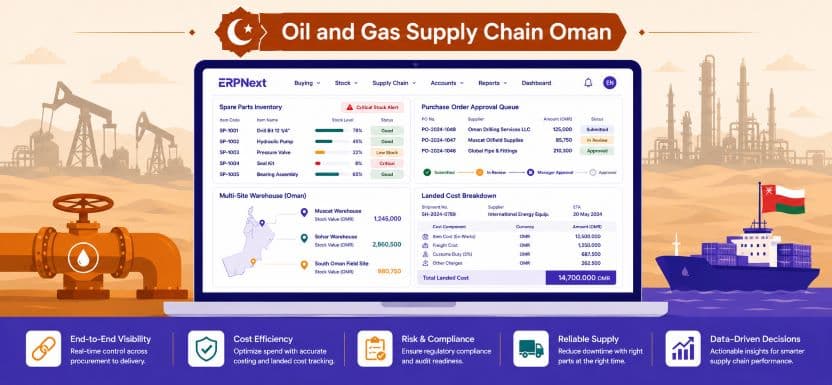
ERPNext Oil Gas Supply Chain Oman: Master Inventory and Procurement for Omani Energy Businesses
Anonymous
ERPNext oil gas supply chain Oman management is one of the most high-stakes operational challenges facing services companies, contractors, and equipment suppliers working across the Sultanate’s energy sector. From Muscat-based procurement offices to field sites in Dhofar, the Rub al Khali borderlands, and offshore platforms in the Arabian Sea, the complexity of managing spare parts inventory, multi-vendor procurement, import landed costs, and Oman VAT compliance simultaneously puts enormous pressure on operations and finance teams. ERPNext addresses every one of these challenges through a single unified platform built for the real-world demands of Omani energy businesses. This guide explains how.
Why ERPNext oil gas supply chain Oman management demands a specialised approach
Oman’s oil and gas sector, anchored by operators such as Petroleum Development Oman, OQ, and Oman LNG, relies on a wide network of service contractors, engineering companies, equipment distributors, and logistics providers. These businesses face supply chain demands that are fundamentally different from retail or light manufacturing. Critical spare parts must be available on demand to prevent production downtime worth thousands of dollars per hour. Import procurement from international suppliers involves complex customs clearance, multi-currency transactions, and VAT landed cost tracking. Vendor qualification, approved supplier lists, and multi-level purchase approvals are not optional processes but contractual and regulatory requirements.
Without an integrated ERP system, most Omani oil and gas services companies manage these demands through disconnected tools: a spreadsheet for inventory, a separate accounting package for finance, email chains for purchase approvals, and manual reports for management visibility. ERPNext oil gas supply chain Oman capability eliminates this fragmentation entirely.
| 35% of oil and gas supply chain costs in Oman are tied to inefficient inventory management | 50% reduction in emergency procurement orders after ERPNext reorder automation | 4x faster vendor evaluation using ERPNext supplier scorecards and performance tracking | 8wk typical ERPNext go-live for an Omani oil and gas services company |
ERPNext oil gas supply chain Oman vs operating without ERP: a direct comparison
| Capability | ERPNext | Without ERP (Current State) |
| Inventory tracking | Real-time multi-warehouse stock levels | Manual spreadsheets or disconnected WMS |
| Reorder automation | Auto purchase orders at defined minimum stock | Manual checks and ad hoc emergency orders |
| Supplier management | Scorecards, lead times, and approved vendor lists | Email and phone-based vendor communication |
| VAT and landed cost | Built-in Oman VAT, freight, customs tracking | Manual calculation per import shipment |
| Spare parts traceability | Serial and batch tracking per asset or equipment | Paper logs or standalone spreadsheets |
| Multi-site visibility | Unified view across all Oman field and office sites | Separate reports consolidated manually |
| Approval workflows | Digital multi-level purchase approvals | Email chains with no audit trail |
| Reporting | Live dashboards and scheduled ERP reports | Monthly Excel reports from multiple sources |
Inventory management for Omani oil and gas businesses with ERPNext
Spare parts and MRO inventory control
Real-time stock visibility across field sites and warehouses
ERPNext oil gas supply chain Oman inventory management gives stores managers and operations directors real-time visibility over every spare part, consumable, and MRO item across all locations simultaneously. Whether your stock is held at a central Muscat warehouse, a Sohar fabrication yard, or a remote field camp in southern Oman, ERPNext reflects current quantities, reserved items, and incoming purchase orders in a single live dashboard. There is no waiting for end-of-day stock counts or manually compiling reports from separate site systems.
Serial number and batch tracking for critical equipment
In the oil and gas sector, traceability is not just operationally useful. It is a safety and contractual requirement. ERPNext tracks every serialised item from purchase receipt through installation, maintenance, and disposal. Batch tracking for consumables such as chemicals, lubricants, and gaskets records lot numbers, supplier certifications, and expiry dates. When an operator audit requires traceability documentation for a specific component fitted to an asset, ERPNext produces a complete material history report in seconds rather than hours.
Minimum stock levels and automated reorder for critical spares
The most financially damaging inventory event in an oil and gas operating environment is an unplanned production shutdown caused by a missing spare part. ERPNext prevents this through configurable minimum stock levels and lead time-aware reorder rules for every critical item. When stock falls below the defined minimum, the system automatically generates a purchase request and routes it through your approval workflow. Operations teams receive alerts before stock reaches zero rather than discovering the gap during a breakdown.
Result: Omani oil and gas services companies using ERPNext report up to 50% reduction in emergency procurement orders within the first six months of go-live through automated reorder management.
Procurement automation with ERPNext oil gas supply chain Oman
Purchase management and vendor control
Approved vendor lists and supplier qualification
Oil and gas operators in Oman typically require their contractors to maintain approved vendor lists (AVLs) for critical equipment and service categories. ERPNext supports AVL management natively, allowing procurement teams to restrict purchase orders for defined item categories to pre-qualified suppliers only. Supplier qualification documents, certifications, and renewal dates are stored against each vendor record with automated expiry alerts, ensuring your procurement team never places an order with an unqualified or lapsed vendor.
Multi-level purchase approval workflows
Every oil and gas business operating in Oman has internal controls around purchase authorisation, whether driven by internal audit requirements, client contractual obligations, or ISO certification. ERPNext oil gas supply chain Oman procurement workflows support multi-level approvals based on purchase value, item category, or project code. A field supervisor can raise a purchase request on mobile, the operations manager approves it, and the finance controller releases payment, with a full digital audit trail at every stage and no paperwork changing hands.
Landed cost tracking for international procurement
Omani oil and gas companies importing equipment and spare parts from Europe, Asia, or North America face complex total cost calculations. The supplier invoice is only the starting point. Freight, marine insurance, Oman customs duties, port handling, and inland transport all contribute to the actual landed cost per unit. ERPNext captures all of these charges against each purchase and calculates true landed cost per item, updating the inventory valuation and cost of sales automatically. This gives finance managers accurate margin data and removes the hidden cost distortions that arise when landed costs are not tracked systematically. For a complete overview of ERPNext financial capabilities for Omani businesses, visit our ERPNext implementation guide for Oman.
VAT-compliant purchasing and OTA-ready reporting
ERPNext oil gas supply chain Oman purchasing is fully integrated with Oman VAT compliance. Input VAT on supplier invoices is captured automatically and reconciled against output VAT on sales invoices for the quarterly OTA return. Import transactions are handled with the correct VAT treatment for goods entering Oman, including reverse charge mechanisms where applicable. The OTA-formatted VAT return report is available on demand at any point during the quarter, not just at period end.
Compliance note: Multi-currency purchase orders in USD, EUR, or GBP are automatically converted to OMR at the transaction exchange rate, with unrealised and realised foreign exchange gains and losses posted to the correct GL accounts.
Multi-site and project-based operations with ERPNext in Oman
Project cost tracking for oil and gas contracts
Most Omani oil and gas services companies operate on a project basis, with revenues and costs that must be tracked per contract, work order, or field campaign. ERPNext project accounting allows every purchase, labour cost, equipment deployment, and subcontractor invoice to be posted against a specific project code. Project managers see live cost-versus-budget dashboards, and finance teams produce client-ready cost reports without manual data extraction from multiple systems.
Multi-warehouse and field site inventory transfers
ERPNext oil gas supply chain Oman architecture supports an unlimited number of warehouse locations within a single company setup. Stock transfers between the central Muscat warehouse and a remote field camp are initiated with a transfer request, approved digitally, and reflected in real time at both locations. There are no stock discrepancies created by delays in updating separate location-specific spreadsheets.
Implementing ERPNext for oil and gas supply chain management in Oman
A focused ERPNext implementation for an Omani oil and gas services company typically follows this phased sequence:
- Weeks 1 to 2: configure the chart of accounts in OMR with project cost centres, set up Oman VAT templates, and import the approved vendor list.
- Weeks 2 to 4: build the item master for spare parts and MRO consumables with serial tracking, reorder levels, and supplier lead times per item.
- Weeks 4 to 6: configure multi-warehouse locations, inter-site transfer workflows, and minimum stock alert rules for critical spares.
- Weeks 5 to 7: activate the purchase module with multi-level approval workflows, AVL restrictions, and landed cost tracking for import shipments.
- Weeks 7 to 9: set up project codes, cost budgets, and live cost-versus-budget dashboards for active Omani contracts.
- Weeks 9 to 12: train stores, procurement, and finance teams, run parallel operations alongside the legacy system, and go live.
Implementation tip: Starting with inventory and procurement simultaneously gives Omani oil and gas businesses the fastest reduction in emergency purchasing costs and the clearest early ROI signal for leadership.
Why ERPNext is the right choice for oil and gas supply chain companies in Oman
- Open source platform with no per-module licence fees, keeping total cost of ownership manageable for mid-sized Omani energy services businesses.
- Native Oman VAT compliance with OTA return reports, multi-currency OMR support, and landed cost tracking built in from day one.
- Full Arabic language interface and Arabic document output for invoices, purchase orders, and inventory reports used by Omani staff.
- Customisable to meet specific operator requirements from PDO, OQ, or other Omani energy clients without expensive proprietary system modifications.
- Local Omani implementation partners with in-country knowledge of energy sector procurement standards, Ministry of Manpower Omanisation requirements, and OTA compliance expectations.
Key advantage: ERPNext oil gas supply chain Oman replaces between four and six disconnected tools that most Omani energy services companies currently operate: an inventory spreadsheet, a standalone accounting system, an email-based procurement process, a separate HR payroll tool, and manual project cost tracking.
Conclusion: master oil and gas supply chain operations in Oman with ERPNext
ERPNext oil gas supply chain Oman management gives energy services businesses, contractors, and equipment distributors across the Sultanate a single platform to control spare parts inventory, automate procurement workflows, track landed costs, manage multi-site operations, and maintain full VAT compliance without the enterprise price tag of SAP or Oracle alternatives.
In an industry where a missing critical spare can cost more than a year of ERP subscription fees in a single day of downtime, the investment case for integrated supply chain management has never been clearer. The Omani oil and gas businesses that build their ERP infrastructure now will be the ones positioned to scale operations, win larger operator contracts, and meet the digitalisation expectations of Vision 2040 clients.
Take the next step: Contact Gazelle today for a free ERPNext supply chain assessment tailored to your Omani oil and gas operations, whether you are an equipment supplier, services contractor, or logistics provider to the energy sector.