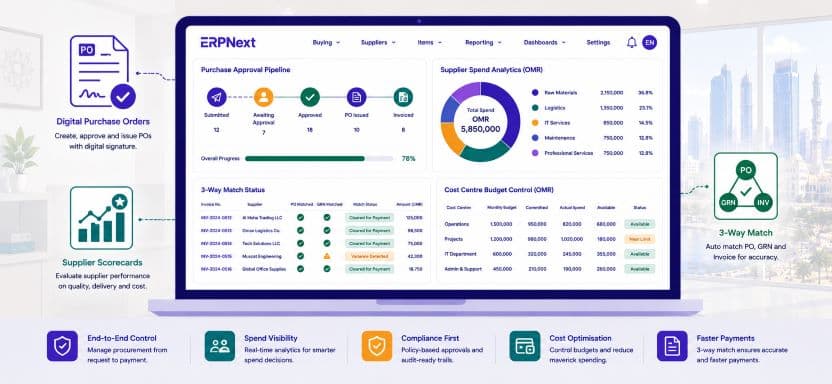
Digital Procurement Oman: Master Cost Cuts and Faster Approvals with ERPNext
Anonymous
Digital procurement Oman ERPNext adoption is accelerating across every sector as Omani businesses face simultaneous pressure to reduce operating costs, tighten financial controls, and meet the digitisation expectations set by Vision 2040. Procurement is the single largest controllable cost category for most Omani businesses, whether they are trading companies, manufacturers, contractors, or service providers. Yet the majority of Omani SMEs still manage purchasing through email chains, WhatsApp messages, paper purchase orders, and manual invoice matching. The result is slow approvals, duplicate payments, unauthorised purchases, and no real-time visibility over where the company’s money is being spent. This guide explains how ERPNext transforms procurement for Omani businesses and why the impact is visible within the first month of go-live.
Why do Oman businesses adopt ERPNext now
The Supreme Council for Planning has set clear digital economy targets under Vision 2040 that extend beyond government services to private sector operations. Omani businesses that continue to rely on manual procurement processes face a growing competitive disadvantage as larger suppliers, government clients, and international partners increasingly expect digital purchase orders, electronic payment trails, and auditable approval workflows as standard. Beyond compliance readiness, the operational cost of manual procurement is itself a compelling argument for change. Research consistently shows that manual purchase order processing costs four to six times more per transaction than an automated digital workflow.
Digital procurement Oman ERPNext implementation addresses this cost gap directly while simultaneously giving finance directors, operations managers, and business owners the spend visibility they need to make better purchasing decisions.
Key stats at a glance:
- 42% of procurement costs in Omani SMEs are tied to manual processing, rework, and emergency orders
- 3x faster purchase order approval when digital workflows replace email chains
- OMR 0 additional licence cost for the full ERPNext procurement module
- 60% reduction in duplicate supplier invoices after three-way matching is activated
Digital procurement Oman ERPNext: before and after comparison
| Procurement Step | Without ERPNext | With ERPNext |
| Purchase request | Email or WhatsApp to line manager | Digital form with auto-routing to approver |
| Approval process | Email chain, 3 to 7 days average | Digital workflow, same day to 48 hours |
| Supplier selection | Personal relationships, no performance data | Approved vendor list with scorecard data |
| Purchase order | Manual Word or Excel template, emailed | Auto-generated, numbered, linked to request |
| Price comparison | Ad hoc, no system record | Supplier quotation comparison in ERPNext |
| Invoice matching | Manual check against paper PO | Three-way match: PO, GRN, and invoice |
| Spend visibility | Month-end report from the accountant | Live dashboard by supplier, category, project |
| Budget control | No real-time check, overruns discovered late | Auto-block if purchase exceeds cost centre budget |
| Audit trail | Email threads, lost attachments | Full digital history per transaction |
| Landed cost tracking | Manual import cost allocation | Auto-calculated per shipment in OMR |
Streamlining purchase requests and approvals with ERPNext in Oman
Digital purchase request forms with automatic routing
The digital procurement workflow in Oman ERPNext begins the moment a staff member raises a purchase request through the ERPNext web interface or mobile app. The request captures the item description, quantity, estimated cost, required date, project or cost centre code, and justification. Upon submission, ERPNext routes the request automatically to the correct approver based on the value and the cost centre, eliminating the delay that occurs when requests are emailed to the wrong person, left in an inbox over a weekend, or verbally approved with no written record.
Multi-level approval workflows configured for Omani business structures
ERPNext approval workflows can be configured to match the exact financial authority structure of any Omani business:
| Purchase Value | Approvers Required | ERPNext Workflow Behaviour |
| Up to OMR 500 | Department head | Mobile notification, approve or reject in app |
| OMR 501 to 2,000 | Department head then finance manager | Sequential two-step, both notified by system |
| OMR 2,001 to 10,000 | Finance manager then General Manager | Sequential two-step, escalates if no response in 24 hrs |
| OMR 2,001 to 10,000 | Finance manager, GM, and Managing Director | Three-step sequential with full audit log |
| Any amount, new supplier | Finance manager plus procurement review | Triggered by supplier flag on purchase request |
Every approval or rejection is timestamped, attributed to a named user, and stored permanently against the purchase record. Approvers receive mobile notifications and can approve from anywhere in Oman or abroad, eliminating the bottleneck of needing a senior manager physically present in the office to sign a purchase order.
Omani businesses that switch from email-based purchase approvals to ERPNext digital workflows typically reduce average approval time from three to seven days down to four to twenty-four hours for standard procurement requests.
Supplier management and cost control with digital procurement, Oman ERPNext
Approved vendor lists and supplier qualification
One of the most effective cost control mechanisms available to Omani procurement managers is restricting purchases of specific item categories to pre-qualified, price-negotiated suppliers. ERPNext supports approved vendor lists at the item level, meaning a purchase order for a specific material can only be raised against suppliers who have been pre-qualified, price-checked, and approved by the procurement team. This prevents maverick spending, eliminates the use of unknown suppliers for critical items, and ensures negotiated rates are applied consistently across every department and project site.
Supplier quotation comparison and price benchmarking
Digital procurement Oman ERPNext includes a built-in request for quotation module that allows procurement teams to send RFQs to multiple suppliers simultaneously and compare their responses in a side-by-side matrix. Price, lead time, payment terms, and additional charges are all captured against each supplier’s response. The lowest compliant quotation can be converted to a purchase order in one click, with the comparison matrix permanently attached to the PO record as an audit document. This replaces the informal phone or email comparison that leaves no record and makes it impossible to verify that the best value option was actually selected.
Three-way matching to eliminate duplicate and fraudulent invoices
ERPNext automatically matches every supplier invoice against the original purchase order and the goods receipt note before allowing payment processing. If the invoice value exceeds the PO value, or if goods were never received, ERPNext blocks the payment and alerts the finance team. Digital procurement Oman ERPNext three-way matching eliminates duplicate supplier invoices, inflated quantities, and fictitious deliveries that cost Omani businesses significantly each year and are almost impossible to catch in a manual system.
Businesses implementing ERPNext three-way matching consistently report a 60% reduction in duplicate invoice processing in the first six months. Every blocked payment attempt is logged with the reason, creating an audit trail that satisfies both internal and external auditor requirements.
Spend analytics and procurement visibility with ERPNext in Oman
Live procurement dashboards for Omani managers
Digital procurement Oman ERPNext delivers real-time spend analytics that most Omani businesses have never had access to before. The following eight analytics views are available as standard in ERPNext without any custom development:
| Analytics View | What It Shows for Omani Procurement Managers |
| Spend by supplier | Top 10 suppliers by OMR value, month or year to date |
| Spend by category | Raw materials, services, IT, logistics, and other cost codes |
| Spend by project | Cost per active project or contract for job costing |
| Spend by cost centre | Department-level procurement cost for budget accountability |
| Supplier lead times | Average days from PO to delivery per supplier |
| On-time delivery rate | Percentage of orders delivered within agreed lead time |
| Price variance | Actual cost versus last purchase price per item |
| Emergency order rate | Percentage of POs raised as urgent, flagged for review |
Budget control and cost centre spend limits
ERPNext allows Omani finance teams to set monthly or annual procurement budgets per cost centre, department, or project. When a purchase request would exceed the available budget, ERPNext can be configured to either block the request automatically or send an alert to the budget owner for authorisation. This real-time budget control replaces the end-of-month discovery that a department has overspent its procurement allocation.
Landed cost tracking for import-heavy Omani businesses
For Omani trading companies, manufacturers, and contractors sourcing goods internationally, the supplier invoice is only one component of the total procurement cost. Freight, insurance, customs duties, and port handling charges can add 15% to 35% to the landed cost per unit. ERPNext landed cost tracking captures all of these charges against each import shipment and allocates them to the correct inventory valuation automatically. Digital procurement Oman ERPNext landed cost accuracy means margin calculations, pricing decisions, and stock valuations reflect the true cost of goods.
Omani businesses implementing ERPNext landed cost tracking for the first time consistently discover their true procurement costs are 12% to 25% higher than their invoice-only figures suggested. This insight alone often justifies the entire ERP investment within the first quarter.
Implementing digital procurement Oman ERPNext: a practical roadmap
Most Omani businesses can complete a focused ERPNext procurement implementation in six to ten weeks:
- Weeks 1 to 2: Configure the supplier master with approved vendor classifications, payment terms, and default currency. Import historical supplier data and set up item categories with cost centre mapping.
- Weeks 2 to 3: Build the procurement approval workflow matrix based on your financial authority schedule. Configure mobile approval notifications for senior managers.
- Weeks 3 to 4: Activate the request for quotation module, set up supplier comparison templates, and configure approved vendor list restrictions for critical item categories.
- Weeks 4 to 5: Enable three-way matching rules for goods-based purchases and configure invoice variance tolerance levels for your finance team.
- Weeks 5 to 7: Set up cost centre budgets, monthly spend limits, and budget alert rules for each department or project.
- Weeks 7 to 10: Train procurement, finance, and operations teams, run parallel processing alongside the old system for two to four weeks, then go live.
The fastest ROI in digital procurement Oman ERPNext implementations consistently comes from activating approval workflow automation and three-way matching in the first phase. These two features alone eliminate the highest-volume manual tasks and the most costly financial control gaps.
Digital procurement as part of a fully integrated Omani ERP system
Digital procurement Oman ERPNext delivers the greatest value when the procurement module operates as part of a fully integrated business system. Purchase costs are posted directly to project cost centres. Inventory reorder signals from the warehouse module trigger procurement requests automatically. Supplier invoice payments flow through accounts payable with full bank reconciliation. VAT on purchases is captured and reconciled for OTA return filing without any manual data transfer. For a complete overview of ERPNext as a fully integrated platform for Omani businesses, visit our ERPNext implementation tips for Omani businesses.
Master digital procurement in Oman with ERPNext
Digital procurement Oman ERPNext gives businesses across the Sultanate the tools to cut procurement costs, accelerate approval cycles, eliminate duplicate payments, and achieve real-time visibility over every purchase from request to payment. The transition from manual procurement to a fully digital ERPNext workflow is not a multi-year enterprise transformation. It is a six to ten-week implementation that most Omani SMEs can complete without disrupting daily operations, and the financial impact is typically visible within the first full procurement cycle after go-live.
Every month that procurement remains manual is another month of paying more than necessary, approving too slowly, and discovering cost overruns after the commitment has already been made.
Contact Gazelle today for a free digital procurement assessment and discover exactly how much your Omani business is currently spending on manual procurement processes that ERPNext can automate.