WPS Payroll Compliance Oman ERPNext: Master Payroll and Labour Law for Omani Businesses
Anonymous
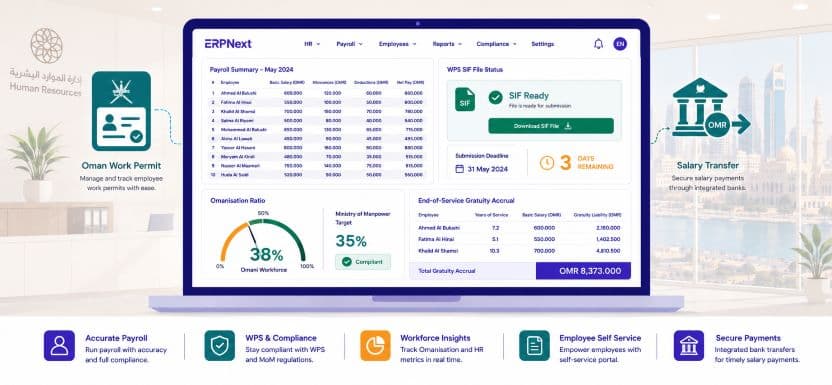
WPS payroll compliance Oman ERPNext management is a critical obligation for every private sector employer in the Sultanate, regardless of company size, industry, or workforce nationality. The Wage Protection System, enforced by the Ministry of Manpower Oman, requires businesses to pay employees on time, in the correct amount, and through an approved financial channel, with a compliant SIF file submitted to prove every payment. Penalties for non-compliance are immediate and financially damaging. Beyond WPS, Omani Labour Law imposes precise rules on leave entitlements, end-of-service gratuity calculations, overtime, and Omanisation ratios that HR teams must track and report without error. ERPNext automates the entire payroll and compliance workflow, eliminating the manual processes that generate mistakes, delays, and Ministry of Manpower penalties. This guide covers every aspect of how ERPNext delivers WPS payroll compliance for Omani businesses.
Understanding WPS payroll compliance in Oman: what businesses must do
The Wage Protection System was introduced in Oman to ensure employees receive their salaries in full and on time through traceable, bank-verified channels. Under WPS, every private sector employer must generate a Salary Information File (SIF) in the Ministry of Manpower’s prescribed format, upload it to their bank’s WPS portal, and complete salary disbursement within the legal deadline. Late payment, incorrect SIF data, or salary amounts that do not match the registered employment contracts trigger automatic fines and can result in permit suspension that prevents further recruitment.
Beyond WPS, Omani Labour Law requires employers to calculate annual leave at the correct rate, manage sick leave and maternity leave entitlements, compute end-of-service gratuity accurately based on tenure and salary, and maintain Omanisation workforce ratios by department and company grade. WPS payroll compliance Oman ERPNext handles all of these requirements from a single payroll module that connects directly to the HR, finance, and reporting layers of the business.
| OMR 500 minimum fine per employee per month for WPS non-compliance in Oman | 72hrs maximum time employers have to process salaries after the payroll due date | 8 hours average time saved per payroll cycle when ERPNext replaces manual payroll in Oman | 100% of ERPNext payroll runs generate a WPS-ready SIF file with no manual formatting |
WPS payroll compliance Oman ERPNext versus manual payroll: a direct comparison
The table below maps eight critical payroll and compliance functions across ERPNext and the manual or legacy system approach.
| Payroll Function | ERPNext | Manual or Legacy System |
| WPS SIF file generation | Automated, one click after payroll run | Manual Excel formatting per pay period |
| Salary payment deadline alerts | System notification before 72hr deadline | Manual calendar reminders, often missed |
| Omani Labour Law leave calc. | Automatic per contract type and tenure | Manual lookup and calculation per employee |
| End-of-service gratuity | Auto-calculated per Omani Labour Law formula | Spreadsheet formula, high error rate |
| Omanisation ratio tracking | Live dashboard by department and site | Monthly manual headcount report |
| Employee self-service | Leave requests and payslips via portal | Paper forms and emailed payslips |
| Payroll audit trail | Full GL posting per employee per component | No ledger linkage, summary entries only |
| Multi-branch payroll | Single run across all Oman locations | Separate manual run per branch or site |
WPS SIF file generation with ERPNext: the complete workflow
From payroll run to bank submission in seven steps
| # | Step | ERPNext Action |
| 1 | Run payroll in ERPNext | All salary components calculated, deductions applied, GL entries posted automatically |
| 2 | Review payroll summary | HR manager checks total payroll, allowances, and deductions before approval |
| 3 | Approve payroll | Finance director approves digitally, triggering WPS file generation |
| 4 | Download WPS SIF file | ERPNext exports the Ministry of Manpower compliant SIF file in one click |
| 5 | Upload to bank WPS portal | SIF file uploaded to Omani bank WPS system for salary disbursement |
| 6 | Salary credited to employees | Bank processes payments to employee accounts across all nationalities |
| 7 | WPS confirmation received | Bank confirmation imported or manually noted in ERPNext payment entry |
The entire WPS payroll compliance Oman ERPNext workflow from step one to step five takes less than 30 minutes for most Omani businesses, compared to the two to four hours typically spent on manual payroll preparation, spreadsheet formatting, and SIF file construction from a template. The GL postings, salary register, and payslips are all generated as part of the same payroll run, with no separate data entry into the accounting system required.
Configure ERPNext to send an automated reminder to the HR manager and finance director five days before the WPS salary deadline each month. This eliminates the single most common cause of WPS penalties in Omani SMEs: the deadline being missed during a busy period.
Omani Labour Law compliance with ERPNext payroll
Leave management, gratuity, and statutory entitlements
Annual leave and sick leave management
Omani Labour Law entitles employees to a minimum of 30 calendar days of annual leave per year after completing one year of service, with leave accruing on a pro-rata basis during the first year. Sick leave entitlements, maternity leave, and emergency leave rules are equally specific. ERPNext configures these entitlements per employee contract type, nationality, and tenure, and tracks every leave request, approval, and balance in real time. Employees submit leave requests through the self-service portal or mobile app, managers approve with a single click, and the leave ledger updates automatically. There is no manual leave card, no HR spreadsheet to update, and no risk of an employee taking more leave than their entitlement allows.
End-of-service gratuity calculation under the Omani Labour Law
End-of-service gratuity is one of the most financially significant payroll obligations for Omani employers, and one of the most error-prone when calculated manually. Omani Labour Law sets specific gratuity rates based on the reason for termination, the employee’s nationality, their tenure, and their basic salary. WPS payroll compliance, Oman ERPNext calculates the correct gratuity amount automatically when an employee record is processed for end of service. The table below shows three example gratuity calculations that ERPNext handles without any manual input:
| Employee Profile | Basic Salary | Years of Service | Applicable Rate | Gratuity Payable (OMR) |
| Omani national, resigned | OMR 600 | 4 years | 15 days per year (1-3 yrs), 1 month thereafter | OMR 1,140 auto-calculated |
| Expatriate, terminated | OMR 900 | 7 years | 15 days per year | OMR 3,150 auto-calculated |
| Omani national, retired | OMR 1,200 | 12 years | 1 month per year | OMR 14,400 auto-calculated |
ERPNext maintains a running gratuity accrual balance per employee in the finance ledger, giving Omani businesses a real-time view of their total end-of-service liability at any point in the year. This is critical for cash flow planning and audit preparation.
Overtime calculation and allowance management
Omani Labour Law specifies overtime payment at 125% of the normal hourly rate for standard overtime and 150% for Friday and public holiday work. ERPNext payroll applies these multipliers automatically based on approved timesheet data, eliminating the manual overtime calculation that generates errors and disputes. Allowances such as housing, transport, and meal allowances are configured per employee grade and applied consistently every payroll cycle without manual entry.
Omanisation compliance and workforce reporting with ERPNext
Real-time Omanisation ratios and Ministry of Manpower reporting
Live Omanisation ratio dashboards
WPS payroll compliance Oman ERPNext extends beyond payroll processing into strategic workforce management. ERPNext provides real-time Omanisation ratio dashboards that update automatically as staff are hired, transferred, or terminated. HR managers and operations directors can filter the ratio view by department, project site, job grade, or company-wide, and identify departments that are approaching or falling below their Ministry of Manpower required ratio before a compliance breach occurs. This proactive visibility replaces the reactive process of discovering a ratio shortfall during a Ministry inspection.
Ministry of Manpower report generation
Periodic workforce reports submitted to the Ministry of Manpower must reflect accurate headcounts, nationality breakdowns, salary levels, and Omanisation ratios as of a specific date. ERPNext generates these reports directly from live HR data with no manual compilation required. The HR team selects the reporting date, runs the report, and exports it in the required format. What previously took two to three days of data gathering across HR, payroll, and operations systems is completed in minutes.
Multi-branch and multi-site payroll management in Oman with ERPNext
Omani businesses operating across multiple governorates or project sites often face the additional challenge of managing separate payroll runs, allowance structures, and Omanisation obligations by location. ERPNext supports multi-branch payroll within a single company setup. Each branch or site can have its own cost centre, its own allowance structure, and its own Omanisation target, while the group-level HR dashboard consolidates all headcount, payroll cost, and compliance data for executive reporting. A single payroll approval covers all locations simultaneously, and the WPS SIF file includes employees across every registered site in the correct Ministry of Manpower format.
Advantage: WPS payroll compliance Oman ERPNext replaces standalone payroll software, separate leave management tools, manual gratuity spreadsheets, and disconnected HR record systems with a single platform that posts every payroll transaction directly to the GL without any manual journal entry.
Setting up WPS payroll compliance Oman ERPNext: a practical configuration checklist
Follow this sequence to configure ERPNext payroll for full Omani WPS and Labour Law compliance:
- Create employee records with contract type, nationality, joining date, basic salary, and allowance structure per Ministry of Manpower-registered employment terms.
- Configure salary components, including basic salary, housing allowance, transport allowance, overtime, and any performance bonuses, with the correct GL account mapping.
- Set up leave types for annual leave, sick leave, maternity leave, and emergency leave with Omani Labour Law entitlement rules per contract type and tenure band.
- Configure end-of-service gratuity rules for Omani national and expatriate employee categories with the correct tenure-based rate schedule.
- Set up WPS bank details for each employee, including IBAN, bank name, and national identification number in the Ministry of Manpower SIF format.
- Define payroll frequency, cut-off dates, and approval workflow with designated approvers for HR review and finance director sign-off.
- Configure Omanisation ratio targets by department and activate the live ratio dashboard for HR and operations management visibility.
- Set up automated payroll deadline reminders five days before each WPS due date for the HR manager and finance director.
Implementation note: Run a parallel payroll for the first two months alongside your existing system to verify that ERPNext calculations match your historical payroll register before fully decommissioning the legacy tool.
ERPNext payroll is part of a fully integrated Omani business system
WPS payroll compliance Oman ERPNext is most powerful when the payroll module operates as part of a fully integrated business system rather than as a standalone HR tool. Labour costs are posted directly to project cost centres for construction and services businesses. Payroll expenses flow into the monthly profit and loss without manual journal entries. Leave balances integrate with project resource planning so managers can see staff availability alongside project schedules. Gratuity accruals appear on the balance sheet in real time for accurate financial reporting and audit preparation. For a complete overview of ERPNext as a fully integrated platform for Omani businesses, visit our ERPNext implementation guide for Omani businesses.
Master WPS payroll compliance in Oman with ERPNext
WPS payroll compliance Oman ERPNext gives every Omani private sector employer the automation, accuracy, and audit trail they need to meet Ministry of Manpower obligations without consuming their HR and finance teams in manual processing. Automated SIF file generation, Omani Labour Law leave calculations, end-of-service gratuity automation, live Omanisation dashboards, and fully integrated GL payroll posting combine to make ERPNext the most complete payroll compliance solution available to Omani businesses at any price point.
Every payroll cycle without an integrated system is another cycle of manual risk: missed deadlines, calculation errors, missing SIF data, and compliance gaps that grow more expensive to resolve the longer they are left unaddressed.
Contact Gazelle today for a free ERPNext payroll compliance demo tailored to your workforce size, industry, and WPS configuration requirements in Oman.