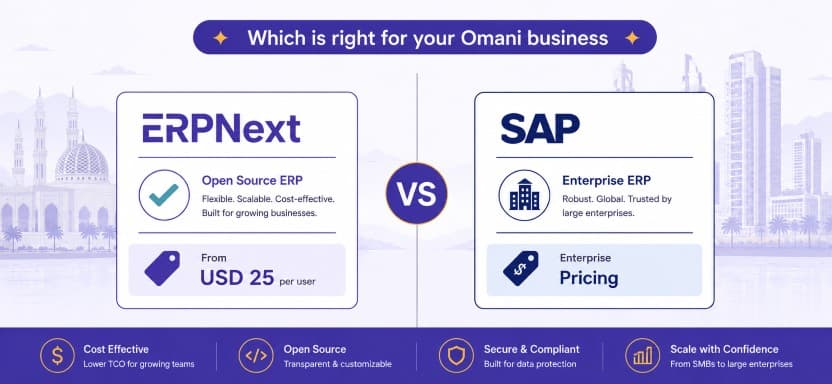
ERPNext vs SAP Oman: Master the Right ERP Choice for Your Omani Business
Anonymous
ERPNext vs SAP Oman is one of the most searched ERP comparisons among Omani business owners, finance managers, and IT decision-makers right now. As Oman’s private sector races to digitise operations under the Vision 2040 agenda, the pressure to choose the right enterprise software platform has never been higher. Both ERPNext and SAP promise to unify your business processes, but they are built for very different types of organisations, budgets, and ambitions. This guide gives you a clear, Oman-specific comparison so you can make a confident decision.
Why the ERPNext vs SAP Oman decision matters more than ever
The Supreme Council for Planning has set clear digital economy targets under Oman Vision 2040, and businesses that delay ERP adoption risk falling behind competitors who are already automating finance, procurement, and HR. But choosing the wrong platform is just as costly as choosing no platform at all. A system that is over-engineered for your current size will drain capital, stall adoption, and create dependency on expensive consultants.
The ERPNext vs SAP Oman comparison is ultimately a question of fit: which platform aligns with the scale, budget, regulatory environment, and growth trajectory of your specific business?
ERPNext vs SAP Oman: direct feature and cost comparison
The table below maps the most decision-critical factors for Omani businesses side by side.
| Factor | ERPNext | SAP Business One / S4HANA |
| Licence cost | Free (open source) | OMR 15,000 to 150,000+ |
| Implementation cost | OMR 3,000 to 20,000 typical | OMR 50,000 to 500,000+ |
| Monthly SaaS cost | From USD 25 per user | USD 150 to 400+ per user |
| Arabic / RTL support | Full Arabic UI and docs | Partial, module dependent |
| Oman VAT compliance | Built in, OTA ready | Requires localisation add-on |
| WPS payroll | Supported natively | Requires configuration |
| Implementation time | 4 to 12 weeks | 6 to 18 months |
| Customisation | Open source, full access | Licensed, vendor dependent |
| Best fit size | 5 to 500 employees | 200 to 10,000+ employees |
Breaking down the cost: ERPNext vs SAP for Omani SMEs
ERPNext total cost of ownership in Oman
ERPNext is open source, which means there are no software licence fees. Omani SMEs typically pay for implementation, customisation, hosting, and ongoing support. A standard ERPNext deployment for a 20 to 50 person Omani business through a local partner costs between OMR 3,000 and OMR 12,000 for implementation, with monthly cloud hosting and support from OMR 150 upward. The full ERPNext vs SAP Oman cost gap becomes clear at this point: most Omani SMEs can be fully live on ERPNext for less than SAP’s annual support fee alone.
SAP total cost of ownership in Oman
SAP Business One, the SME-targeted SAP product, starts at roughly OMR 15,000 in licence costs alone for a small team, with implementation projects typically running OMR 50,000 to OMR 200,000 for mid-sized Omani companies. SAP S/4HANA, the enterprise platform, routinely exceeds OMR 500,000 in total first-year cost including mandatory annual maintenance fees, certified partner implementation charges, and localisation work for Oman VAT and Arabic language requirements that are not always included out of the box.
Oman localisation: ERPNext vs SAP Oman compared
VAT compliance and OTA integration
ERPNext VAT compliance for Oman is built in. Tax invoice templates, 5% VAT calculation, TRN fields, and OTA-formatted return reports are available without additional modules or consultancy fees. SAP requires localisation packages or partner-built add-ons for Oman VAT, adding both cost and implementation time. For Omani SMEs who need VAT compliance from day one, ERPNext vs SAP Oman delivers a clear advantage. For a deeper look, read our ERPNext VAT compliance guide for Oman.
Arabic language and RTL document support
ERPNext ships with a full Arabic interface, right-to-left document rendering, and Arabic print templates for invoices, purchase orders, and HR letters. SAP Business One offers partial Arabic support depending on version, region, and partner configuration. For Omani businesses whose teams primarily operate in Arabic, this is a day-to-day usability factor that directly affects system adoption rates.
WPS payroll and Omani Labour Law compliance
ERPNext handles Wage Protection System payroll, end-of-service gratuity under Omani Labour Law, and leave entitlements natively. SAP requires HR module configuration and in some cases custom development to meet the same standards. In the ERPNext vs SAP Oman HR comparison, ERPNext reduces implementation time for payroll compliance from weeks to days.
When SAP is the right choice for an Omani business
This guide is not anti-SAP. There are Omani businesses for which it is genuinely the right choice. Consider SAP if your organisation meets most of these criteria:
- You have more than 200 employees and manage complex multi-entity operations across multiple countries.
- Your industry has specific SAP-certified vertical solutions such as oil and gas upstream operations or large-scale manufacturing with MES integration.
- You have an in-house IT team of at least 3 to 5 people capable of managing SAP configuration and upgrades.
- You are planning a regional or international expansion that requires SAP’s multi-jurisdictional compliance framework.
- Your capital ERP budget exceeds OMR 100,000 and you have executive commitment to an 18-month implementation cycle.
Important note: If your business does not meet at least four of the five criteria above, ERPNext will almost always deliver better ROI, faster time to value, and lower risk for an Omani SME.
When ERPNext is the right choice for an Omani business
ERPNext is the stronger choice for the vast majority of Omani SMEs. It is the right platform when:
- Your team has between 5 and 200 employees and you need a unified system for finance, HR, inventory, and sales without a multi-year implementation.
- You need Oman VAT compliance, Arabic invoices, and WPS payroll live within 8 to 12 weeks, not 12 to 18 months.
- Your ERP budget is under OMR 30,000 for full implementation and you want predictable monthly operating costs.
- You value the ability to customise and extend your system as Omani regulations evolve without paying SAP licence fees for every change.
- You want a local Oman implementation partner who understands OTA requirements, Omanisation ratios, and Vision 2040 compliance expectations.
ERPNext advantage: Omani SMEs that implement ERPNext typically go live within 6 to 10 weeks and recover their full implementation cost within the first year through time savings on manual finance and HR processes.
Conclusion: master your ERPNext vs SAP Oman decision with confidence
The ERPNext vs SAP Oman comparison comes down to one core question: what does your business actually need right now, and what will it need in the next three years? For the overwhelming majority of Omani SMEs, ERPNext delivers enterprise-grade capability at a fraction of SAP’s cost, with better out-of-the-box localisation for Oman’s regulatory environment and a faster path to business value. For large enterprises with complex multi-country operations and dedicated IT teams, SAP remains a powerful choice.
Every quarter without a unified ERP system is a quarter of manual errors, missed compliance obligations, and lost visibility into your business performance. The decision does not need to wait. Ready to make your choice? Contact Gazelle for a free ERPNext vs SAP Oman consultation and get a tailored recommendation based on your business size, industry, and budget.