ERPNext Trading Company Oman: Master Import and Export Operations for Omani Traders
Anonymous
ERPNext trading company Oman operations management is one of the most compelling use cases for the platform in the Sultanate. Omani trading companies sit at the intersection of the most complex business processes any SME can face: international supplier procurement in multiple currencies, customs clearance and landed cost allocation, domestic distribution across multiple governorates, VAT-compliant invoicing under Ministry of Finance regulations, and client billing that spans Omani private companies, government entities, and GCC export customers simultaneously.
Most Omani trading companies currently manage this complexity through a patchwork of disconnected tools: a legacy accounting system, procurement tracked in spreadsheets, inventory managed in a separate warehouse application, and customer billing handled manually. ERPNext replaces all of it with a single unified platform built for exactly how Omani import and export trading businesses operate. This guide explains every capability that matters for your trading operation.
Why ERPNext trading company Oman management solves a unique problem
Omani trading companies face a set of operational challenges that generic accounting software was never designed to address. An electronics distributor importing from China and South Korea, reselling to retailers across Muscat, Sohar, and Salalah, and exporting to GCC buyers in Kuwait and Bahrain simultaneously manages USD purchase invoices, CNY supplier negotiations, OMR domestic sales, AED export invoices, Oman VAT on domestic supplies, zero-rated VAT on qualifying exports, landed cost calculations that vary by shipment, and inventory that moves between a central Muscat warehouse and regional distribution points. Each of these dimensions creates a specific management challenge. Together, they make manual systems not just inefficient but genuinely dangerous from a financial accuracy and compliance perspective.
ERPNext trading company Oman implementation addresses every one of these dimensions from a single platform with no additional modules to purchase and no integration middleware to maintain between systems.
Key trading company performance stats with ERPNext:
- 50% reduction in time spent on monthly VAT reconciliation for Omani trading companies after ERPNext go-live
- 3x faster landed cost calculation per import shipment compared to manual spreadsheet allocation
- OMR 0 additional licence cost for the full ERPNext trading, procurement, and inventory suite
- 40% reduction in stock discrepancies between central warehouse and branch locations within six months
Import procurement management with ERPNext trading company Oman
Supplier master and approved vendor management
The import procurement cycle for an Omani trading company begins with supplier management. ERPNext stores every international supplier with their default transaction currency, payment terms, lead time, country of origin, and approved item categories. For a Muscat trading company sourcing from ten countries simultaneously, this centralised supplier master eliminates the inconsistency of different buyers using different spreadsheets to track the same supplier relationship. Approved vendor lists at the item level ensure that category managers cannot raise purchase orders for critical product lines against unapproved suppliers, protecting the negotiated pricing and quality standards the commercial team has established.
Multi-currency purchase orders in USD, AED, EUR, and CNY
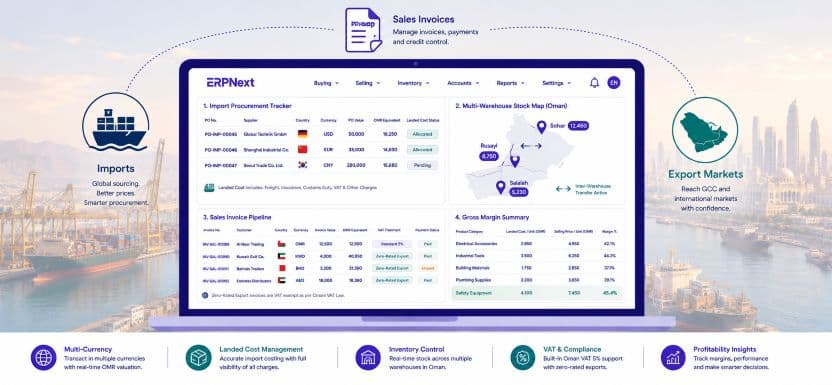
Every import purchase order in ERPNext is raised in the supplier’s transaction currency. A shipment of industrial tools from a German supplier is ordered in EUR. Electronics from a Korean manufacturer are ordered in USD. Packaging materials from a Chinese supplier are ordered in CNY. ERPNext applies the exchange rate at the transaction date, calculates the OMR equivalent, and posts the correct OMR figure to the purchase ledger automatically. When payment is made at a different rate thirty to sixty days later, ERPNext records the realised foreign exchange gain or loss without any manual journal entry. ERPNext trading company Oman finance teams no longer spend hours reconciling the difference between what they ordered in USD and what they paid in OMR.
Landed cost tracking across every import shipment
The supplier invoice price is only the starting point of the true cost of imported goods for an Omani trading company. Freight from the port of origin, marine insurance, Oman customs duties, port handling at Sohar or Muttrah, and inland transport to the Muscat warehouse all contribute to the actual landed cost per unit. ERPNext captures all of these charges against each specific shipment and allocates them proportionally across every item in the shipment based on quantity, weight, or value, depending on the allocation method your finance team configures. The inventory valuation updates automatically to reflect the true landed cost per unit, meaning your selling price calculations, margin reports, and stock valuations are all based on accurate figures rather than the invoice-only cost that most Omani trading companies currently use.
Omani trading companies implementing ERPNext landed cost tracking for the first time typically discover their true product costs are 15% to 30% higher than their invoice-only figures showed. This discovery directly improves pricing accuracy and protects margins that were previously being quietly eroded.
Inventory management for Omani trading companies with ERPNext
Multi-warehouse stock control across Oman locations
ERPNext trading company Oman inventory management supports an unlimited number of warehouse locations within a single company setup. A trading company operating a central distribution warehouse in Rusayl Industrial Area, a satellite store in Sohar for northern Oman distribution, and a consignment stock holding point in Salalah for southern clients manages all three locations from a single ERPNext dashboard. Stock levels, reorder alerts, inter-warehouse transfer requests, and inventory valuations are all visible in real time across every location without any manual stock report compilation or phone calls between site managers.
Batch and serial number tracking for imported goods
Omani trading companies distributing electronics, medical devices, industrial equipment, or food products face traceability requirements from both their clients and Omani regulatory bodies. ERPNext batch tracking records the supplier lot number, country of origin, import date, customs declaration reference, and expiry date where applicable for every batch received. Serial number tracking captures the unique identifier for every high-value serialised item from receipt through sale to the end customer. When a recall or warranty claim arises, ERPNext produces the complete traceability report from supplier invoice to customer delivery in seconds.
Automatic reorder and purchase request generation
Stock-outs in a trading company create immediate revenue loss and customer relationship damage. ERPNext prevents stock-outs through configurable minimum stock level rules per item per warehouse. When the Rusayl warehouse stock of a fast-moving product falls below the defined minimum, ERPNext automatically generates a purchase request and routes it to the procurement team for supplier quotation and order placement. The reorder quantity is calculated based on the configured economic order quantity and the supplier lead time stored in the item master, ensuring the replenishment order arrives before the remaining stock is exhausted.
| Inventory Feature | ERPNext Capability | Business Impact for Omani Traders |
| Multi-warehouse visibility | Real-time stock across all Oman locations | No manual stock report compilation |
| Landed cost allocation | Auto-allocated per shipment by quantity or value | Accurate product cost and margin data |
| Batch tracking | Lot number, origin, expiry per batch | Full import traceability for recalls |
| Serial tracking | Unique ID from receipt to customer | Warranty and regulatory compliance |
| Reorder automation | Auto purchase request at minimum stock | Zero stock-outs on A-grade products |
| Inter-branch transfers | Digital request and approval workflow | Balanced stock across all locations |
Export sales and client billing with ERPNext trading company Oman
GCC and international export invoicing
For Omani trading companies exporting to GCC markets, ERPNext generates export sales invoices in the buyer’s currency with the correct VAT treatment applied automatically. Exports of goods to GCC countries outside Oman are typically zero-rated under Oman VAT rules when conditions are met. ERPNext flags these transactions as zero-rated based on the customer’s country and the transaction type, ensuring that output VAT is not incorrectly charged on qualifying export invoices and that the zero-rated supply is correctly reported in the OTA VAT return. ERPNext trading company Oman export billing eliminates the manual VAT treatment decision that currently creates compliance risk on every cross-border sale.
Domestic sales invoicing with VAT compliance
For domestic Omani sales to retailers, contractors, and government entities, ERPNext generates VAT-compliant tax invoices with the seller’s TRN, itemised VAT at 5%, and Arabic or English output depending on the customer’s preference. Government entity billing often requires Arabic invoices with specific reference fields. ERPNext configures these requirements per customer so the correct invoice format is applied automatically without the billing team needing to remember which customer requires which format.
Credit management and customer outstanding tracking
Omani trading companies typically extend credit terms of 30 to 90 days to their domestic clients. Managing the resulting receivables across dozens of active customer accounts manually creates a significant collections management challenge. ERPNext aged debtor reports show every customer’s outstanding balance by ageing bucket, the days overdue, and the credit limit utilisation in real time. Automated payment reminder workflows send overdue notices to customers at configurable intervals without requiring manual follow-up from the finance team. The credit limit control feature automatically blocks new sales orders for customers who have exceeded their approved credit limit until the finance manager grants an override.
ERPNext trading company Oman receivables management consistently reduces average debtor days by 8 to 15 days within the first six months of go-live for Omani trading businesses, directly improving cash flow without increasing the finance team headcount.
VAT compliance for Omani trading companies with ERPNext
Input VAT on imports and output VAT on domestic sales
The VAT position of an Omani trading company is more complex than a simple service business. Input VAT is paid on domestic supplier invoices and potentially on import-related charges. Output VAT is collected on domestic sales. Exports may be zero-rated. Some product categories may be exempt. ERPNext handles all four VAT categories simultaneously on a transaction-by-transaction basis. The quarterly OTA VAT return report consolidates every supply and acquisition into the correct box in the OTA return format, ready for submission without any manual calculation or spreadsheet consolidation. For a full overview of ERPNext financial and VAT capabilities for Omani businesses, visit our ERPNext implementation guide for Omani businesses.
VAT on GCC imports and the reverse charge mechanism
Omani trading companies importing from GCC member states where VAT applies need to correctly account for the reverse charge mechanism on qualifying intra-GCC supplies. ERPNext supports reverse charge VAT posting, ensuring that the input VAT and corresponding output VAT entries are created automatically on the correct GL accounts without manual journal entries. This technical VAT compliance capability protects trading companies from the audit risk that arises when reverse charge transactions are either missed entirely or posted incorrectly in legacy systems.
Financial reporting for Omani trading company management
Gross margin by product category and supplier
ERPNext trading company Oman reporting gives commercial directors and business owners the margin visibility that legacy accounting systems cannot provide. Because landed costs are allocated to inventory at receipt, the gross margin on every sale reflects the true cost of goods including all import charges, not just the supplier invoice price. Margin reports can be filtered by product category, supplier, customer, sales region, or individual transaction, enabling the commercial team to identify which product lines are genuinely profitable and which are consuming margin through hidden import costs.
Working capital and cash flow dashboards
Omani trading companies are cash flow intensive businesses. Stock holdings represent significant working capital, supplier payment terms create cash outflow obligations, and customer credit terms delay cash inflow. ERPNext provides live working capital dashboards showing current stock value by location, total accounts payable by ageing and currency, total accounts receivable by ageing, and projected cash flow based on payment due dates. This real-time financial visibility gives Omani trading company owners the information they need to make working capital decisions daily rather than waiting for a monthly report from the accountant.
Implementing ERPNext for an Omani trading company: recommended phase sequence
- Weeks 1 to 2: Configure chart of accounts in OMR, set up Oman VAT templates including zero-rated export category, enter TRN, and configure multi-currency bank accounts for USD, AED, EUR, and any other transactional currencies.
- Weeks 2 to 3: Build supplier master with transaction currencies, payment terms, and lead times. Configure approved vendor lists for critical product categories and multi-level purchase approval workflows.
- Weeks 3 to 4: Set up item master with batch or serial tracking as required, configure warehouse locations, set reorder levels per item per warehouse, and activate landed cost tracking categories.
- Weeks 4 to 5: Configure customer master with credit limits, payment terms, default currencies, and invoice format preferences for Arabic and English outputs.
- Weeks 5 to 6: Set up export customer VAT categories for zero-rated GCC and international sales, activate reverse charge mechanism for applicable intra-GCC purchase categories.
- Weeks 6 to 8: Import master data, verify opening stock through physical count, enter opening balances, conduct user acceptance testing across the full import and export transaction cycle, train staff, and go live.
Configure and test the landed cost module before importing any stock. Opening inventory valuations that do not include landed cost components will produce inaccurate margin reports from the very first sale, and correcting historical valuations post-go-live is a complex and time-consuming exercise.
Master import and export operations for your Omani trading business with ERPNext
ERPNext trading company Oman management gives importers, exporters, and distributors across the Sultanate a single platform to manage the full complexity of international procurement, multi-currency finance, multi-warehouse inventory, VAT-compliant domestic billing, and zero-rated export invoicing without the enterprise price tag of SAP or the compliance gaps of legacy accounting software. The combination of landed cost accuracy, real-time inventory visibility, automated VAT treatment, and live margin reporting transforms how Omani trading company owners and finance directors understand and manage their business every single day.
Contact Gazelle today for a free ERPNext trading company assessment tailored to your Omani import and export operations, product categories, and growth plans.