ERPNext Healthcare Oman: Master Patient Billing and Inventory for Clinics and Hospitals
Anonymous
ERPNext healthcare Oman is transforming how private clinics, polyclinics, and hospitals across the Sultanate manage their two most operationally critical functions: patient billing and medical inventory. As the Ministry of Health in Oman accelerates its push toward digital health infrastructure under Vision 2040, healthcare providers face mounting pressure to digitise financial workflows, eliminate billing errors, and maintain audit-ready records. ERPNext offers a proven, affordable, and fully localised platform built for exactly these challenges. This guide walks you through how it works in practice for Omani healthcare facilities.
The healthcare administration challenge in Oman
Oman’s private healthcare sector has grown rapidly over the past decade, with dozens of new specialist clinics, day-surgery centres, and multi-specialty hospitals opening across Muscat, Sohar, Salalah, and Nizwa. This growth has exposed a serious operational gap: most facilities still rely on disconnected systems for billing, pharmacy stock, supplier procurement, and staff payroll. The result is billing errors, stock-outs of critical medicines, duplicate supplier invoices, and a finance team buried in manual reconciliation work at month’s end.
ERPNext healthcare Oman addresses all of these problems from a single unified platform, with no separate modules to license and no integration middleware to manage.
| 60% reduction in billing errors reported by ERPNext healthcare users | 3x faster pharmacy stock replenishment with automated reorder rules | OMR 0 additional licence cost for ERPNext core modules |
Patient billing with ERPNext healthcare Oman: how it works
Automated patient invoicing with VAT compliance
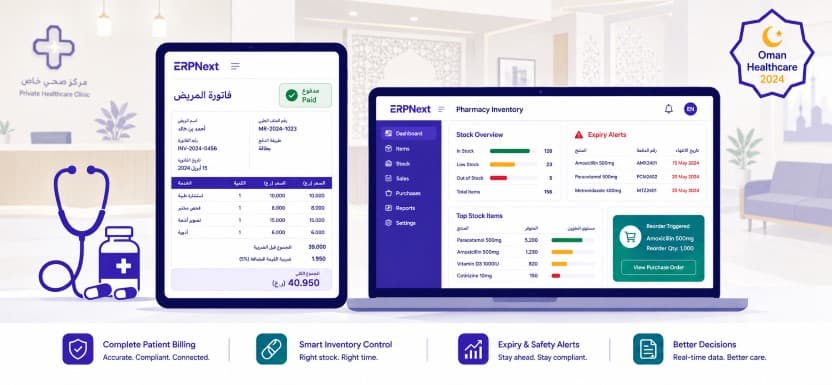
Every patient visit, procedure, or service in ERPNext generates a tax-compliant invoice automatically. The system applies the correct VAT treatment, including zero-rated exemptions for qualifying medical services under Oman Tax Authority guidelines, and prints the patient’s invoice with the facility’s Tax Registration Number (TRN) and itemised service breakdown. Billing staff no longer calculate VAT manually or chase service charge lists on paper. ERPNext healthcare Oman ensures every invoice is accurate, consistent, and OTA-ready from the moment it is created.
Insurance and corporate billing management
A large proportion of patients at Omani private healthcare facilities are covered by employer health insurance or direct billing agreements with insurers. ERPNext supports multi-payer billing, allowing your team to assign each patient encounter to the correct payer, split bills across insurance and patient-paid portions, and track outstanding receivables by insurer. Monthly insurer reconciliation reports that previously took two to three days now run in minutes, giving your finance manager real-time visibility over outstanding claims.
Arabic language billing and patient records
ERPNext ships with full Arabic interface support and right-to-left document rendering. Patient invoices, receipts, and statements can be printed in Arabic, English, or both on the same document. For Omani facilities serving a predominantly Arabic-speaking patient base, this removes a daily friction point and reduces errors caused by staff manually translating service names.
Medical inventory management with ERPNext healthcare in Oman
Pharmacy and consumable stock control
ERPNext healthcare Oman gives pharmacy managers complete visibility over drug stock levels, batch numbers, expiry dates, and supplier lead times from a single dashboard. Automated reorder rules trigger purchase orders when stock falls below defined minimum levels, eliminating the stock-outs that disrupt patient care and emergency orders that inflate procurement costs. Batch and serial number tracking ensures full traceability for controlled substances and high-value medical devices, a requirement increasingly enforced by Omani regulatory inspections.
Expiry date tracking and wastage reduction
Pharmaceutical wastage from expired stock is one of the highest hidden costs in Omani clinic and hospital operations. ERPNext flags items approaching their expiry date 30, 60, or 90 days in advance based on rules you configure. This gives procurement teams time to return items to suppliers, redistribute stock across branches, or prioritise consumption. Facilities using ERPNext healthcare Oman for pharmacy management consistently report significant reductions in expired stock write-offs within their first year.
Multi-branch and multi-store inventory
For healthcare groups operating multiple clinics across Oman, ERPNext supports multi-warehouse inventory from a single system. Central pharmacy stock, branch clinic dispensaries, operating theatre consumables, and diagnostic lab reagents are all tracked in one place. Inter-branch stock transfers are managed with full approval workflows, ensuring that stock movement is always authorised, documented, and reflected in real-time across all locations.
Financial management and reporting for Omani healthcare providers
Beyond billing and inventory, ERPNext healthcare Oman delivers a complete financial management layer that most standalone clinic billing systems lack entirely. The accounts module handles supplier invoice processing, payment runs, bank reconciliation, and cash flow forecasting in Omani Rial. The payroll module manages doctor and nurse salaries, end-of-service gratuity under Omani Labour Law, and WPS-compliant payroll files. Monthly profit and loss statements, department-level cost centre reports, and VAT return summaries are all available on demand without exporting to spreadsheets. For a complete overview of ERPNext financial capabilities for Omani businesses, visit our ERPNext implementation guide for Oman.
Implementing ERPNext healthcare in Oman: a practical roadmap
Most Omani clinics and small hospitals can complete a phased ERPNext implementation in 8 to 14 weeks. A proven sequence is:
- Week 1 to 2: configure the chart of accounts in OMR, set up VAT templates, and import the patient services price list.
- Week 2 to 3: set up the pharmacy item master with batch tracking, reorder levels, and supplier lead times.
- Week 3 to 5: configure insurance payer accounts, billing workflows, and patient invoice templates in Arabic and English.
- Week 5 to 7: set up HR records, Omani Labour Law leave policies, and WPS payroll for clinical and administrative staff.
- Week 7 to 10: train billing, pharmacy, and finance staff on their daily workflows and run a parallel operation period alongside the legacy system.
- Week 10 to 14: go live, decommission legacy systems, and activate executive dashboards for revenue, stock, and payroll.
Implementation tip: Starting with billing and pharmacy simultaneously gives Omani healthcare facilities the fastest return on investment, as these two modules eliminate the highest volumes of manual work from day one.
Why ERPNext is the right choice for healthcare providers in Oman
- Zero software licence cost means more budget for clinical equipment and patient care rather than IT contracts.
- Built-in Oman VAT compliance removes the need for a separate billing system add-on to meet OTA requirements.
- Open source architecture allows customisation for the Omani Ministry of Health reporting formats as regulations evolve.
- Arabic RTL support ensures clinical and administrative staff can work in their preferred language from day one.
- Local Omani implementation partners provide in-country support, reducing dependency on overseas consultants.
Key advantage: ERPNext healthcare Oman replaces three to five separate software tools that most Omani clinics currently pay for individually: billing software, pharmacy stock management, accounting software, HR and payroll, and a reporting tool.
Conclusion: master healthcare operations in Oman with ERPNext
ERPNext healthcare Oman gives clinics and hospitals across the Sultanate the operational foundation they need to deliver excellent patient care without being held back by manual billing errors, pharmacy stock-outs, and disconnected financial systems. The platform handles patient invoicing, VAT compliance, pharmacy inventory, multi-branch stock management, and payroll within a single unified system at a cost that makes sense for facilities of every size.
As Oman’s healthcare sector continues to grow and digital health regulations tighten, the facilities that invest in proper ERP infrastructure today will be the ones positioned to scale, comply, and compete tomorrow.
Take the next step: Contact Gazelle today for a free ERPNext healthcare demo tailored to your clinic or hospital’s specific workflows in Oman.