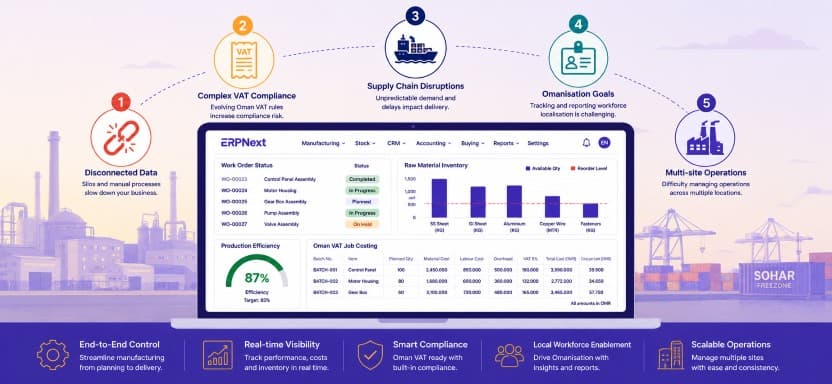
ERP Challenges Omani Manufacturers Face: Master the Top 5 and Solve Them with ERPNext
Anonymous
ERP challenges Omani manufacturers face are not abstract technology problems. They are daily operational pain points that slow production, inflate costs, and put regulatory compliance at risk. As Oman pushes toward a diversified industrial economy under Vision 2040, the pressure on manufacturing businesses to modernise their systems has never been more direct. Yet many Omani factories, food processors, building materials producers, and packaging companies are still running on spreadsheets, disconnected accounting software, and manual production records. This guide identifies the top 5 ERP challenges Omani manufacturers encounter and explains exactly how ERPNext solves each one.
Why ERP challenges Omani manufacturers face are unique to the Gulf
Omani manufacturing businesses operate within a specific set of constraints that generic ERP advice does not address. The Supreme Council for Planning has set ambitious industrialisation targets under Vision 2040, which means manufacturers face simultaneous pressure to scale production, comply with evolving VAT and labour regulations, meet Omanisation workforce ratios, and compete with imports on price and quality. These overlapping demands make choosing and implementing the right ERP system a strategic decision, not just a software purchase.
The ERP challenges Omani manufacturers experience are shaped by this context. Understanding them clearly is the first step to solving them efficiently.
| 68% of Omani SMEs still rely on disconnected systems for production planning | 40% average reduction in raw material waste after ERP implementation | 3x faster supplier invoice processing with ERPNext purchase automation | 12wk typical ERPNext go-live timeline for an Omani manufacturer |
Quick reference: top 5 ERP challenges Omani manufacturers face and the ERPNext solution
| # | Challenge | ERPNext Solution | Business Outcome |
| 1 | Disconnected production and inventory data | ERPNext BOM and work order integration | Real-time shop floor visibility |
| 2 | VAT and cost accounting complexity | Built-in Oman VAT templates and job costing | OTA-compliant invoicing from day one |
| 3 | Supplier lead time and procurement risk | ERPNext purchase module with reorder rules | Reduced stock-outs and emergency orders |
| 4 | Omanisation reporting and HR compliance | Native WPS payroll and ratio dashboards | Ministry submissions in minutes |
| 5 | Multi-site production and warehouse visibility | Multi-warehouse and inter-branch transfers | One view across all sites |
Challenge 1: Disconnected production planning and inventory data
The challenge
Most Omani manufacturers manage production schedules in one tool, raw material inventory in another, and finished goods stock in a third. When a production order is created, there is no automatic check on whether raw materials are available. When stock is consumed on the shop floor, the warehouse record is updated hours or days later. This disconnect is one of the most common ERP challenges Omani manufacturers report, and it creates a cascade of problems: over-purchasing, unexpected stock-outs, production delays, and inaccurate cost-of-goods calculations.
The ERPNext solution
ERPNext connects production planning, bill of materials (BOM), work orders, and inventory in a single real-time system. When a work order is created, ERPNext automatically checks raw material availability against the BOM and triggers a material request if stock is insufficient. As production progresses, stock is consumed in real time against the work order. Finished goods are received into inventory the moment production is confirmed. Omani manufacturers using ERPNext eliminate the data lag that causes most production floor disruptions.
Result: Real-time shop floor and warehouse visibility with zero manual stock reconciliation between production and stores teams.
Challenge 2 VAT complexity and manufacturing cost accounting
The challenge
VAT compliance for Omani manufacturers is more complex than for a simple trading business. Input VAT on raw material purchases, output VAT on finished goods sales, zero-rated exports, and job costing for multi-stage production processes all need to be tracked simultaneously and accurately. This is among the most operationally costly ERP challenges Omani manufacturers face, particularly for facilities that export to GCC markets where VAT treatment varies by destination.
The ERPNext solution
ERPNext handles Oman VAT natively with built-in tax templates for standard-rated, zero-rated, and exempt transactions. The job costing module tracks direct material, direct labour, and overhead costs per production batch or work order, giving finance managers accurate gross margin data by product line. VAT return reports map directly to OTA submission formats, and export invoices can be flagged as zero-rated automatically based on the customer’s address. For a complete walkthrough of ERPNext VAT capabilities in Oman, visit our ERPNext VAT compliance guide for Omani businesses.
Result: Accurate job costing per production run and OTA-compliant VAT returns generated in minutes rather than days.
Challenge 3 Supplier lead time uncertainty and procurement risk
The challenge
Omani manufacturers importing raw materials from Asia, Europe, or within the GCC face variable lead times, port clearance delays, and currency fluctuations that make procurement planning difficult. Without an integrated ERP system, procurement teams rely on historical knowledge and manual reminders rather than system-driven reorder signals. This is one of the most financially damaging ERP challenges Omani manufacturers encounter, as both over-stocking and under-stocking carry direct cost consequences in a production environment.
The ERPNext solution
ERPNext purchase management allows Omani manufacturers to define reorder levels and reorder quantities for every raw material, with automatic purchase order generation when stock falls below the minimum level. Supplier lead times are stored in the system and factored into reorder timing. Landed cost tracking captures freight, customs, and clearance charges against each purchase, giving accurate total acquisition cost per unit. Supplier scorecards track on-time delivery performance over time, enabling data-driven supplier rationalisation decisions.
Result: Procurement driven by real inventory data and supplier performance metrics rather than gut instinct and manual follow-ups.
Challenge 4 Omanisation compliance and HR reporting
The challenge
Omaniisation ratio requirements from the Ministry of Manpower are a non-negotiable compliance obligation for every Omani manufacturer. Tracking the ratio of Omani to expatriate workers across departments, generating compliant payroll under WPS, calculating end-of-service gratuity correctly, and producing Ministry-formatted reports are among the recurring ERP challenges Omani manufacturers describe as most time-consuming. A single compliance breach can result in permit restrictions that halt recruitment and production expansion.
The ERPNext solution
ERPNext HR and payroll handles WPS-compliant payroll files, end-of-service gratuity calculations under Omani Labour Law, and leave entitlement tracking for all employee categories. Omanisation ratio dashboards update in real time as headcount changes, with the ability to filter by department, site, or job grade. Ministry of Manpower report formats can be configured as standard exports so HR teams produce compliant submissions in minutes rather than compiling them manually from spreadsheets.
Result: Full Omanisation ratio visibility, WPS payroll compliance, and Ministry HR reports generated automatically with every payroll cycle.
Challenge 5 Multi-site production and warehouse visibility
The challenge
A growing number of Omani manufacturers operate production facilities in industrial zones like Sohar Freezone, Rusayl, or Salalah Free Zone alongside head office operations in Muscat. Managing inventory, production orders, and financial reporting across multiple locations in disconnected systems creates the fifth and most strategically limiting of the ERP challenges Omani manufacturers face: no single version of the truth across the business.
The ERPNext solution
ERPNext multi-warehouse and multi-branch architecture gives Omani manufacturers a consolidated view of stock, production, procurement, and finance across every site from one system. Inter-branch stock transfers are managed with full approval workflows and are reflected in real time across all locations. Each site can operate its own cost centre for financial reporting, while the group-level dashboard aggregates revenue, margin, and inventory data for executive decision-making.
Result: One unified system view across Muscat head office, Sohar Freezone production, and any other Omani operating location without custom integrations or data exports.
Conclusion: master ERP challenges Omani manufacturers face with ERPNext
The ERP challenges Omani manufacturers face are solvable, and ERPNext addresses all five with a single open-source platform at a fraction of the cost of SAP or Oracle alternatives. From real-time production and inventory integration to VAT-compliant job costing, smart procurement automation, Omanisation HR compliance, and multi-site visibility, ERPNext gives Omani manufacturing businesses the operational foundation they need to compete, scale, and meet Vision 2040 industrial targets.
The manufacturers who invest in solving these ERP challenges now will be the ones positioned to win contracts, pass audits, and expand capacity over the next decade. Those who delay will continue to absorb the hidden costs of disconnected systems, quarter after quarter.
Take the next step: Contact Gazelle today for a free ERPNext manufacturing assessment tailored to your Omani production facility, whether you operate in food processing, building materials, plastics, or industrial manufacturing.