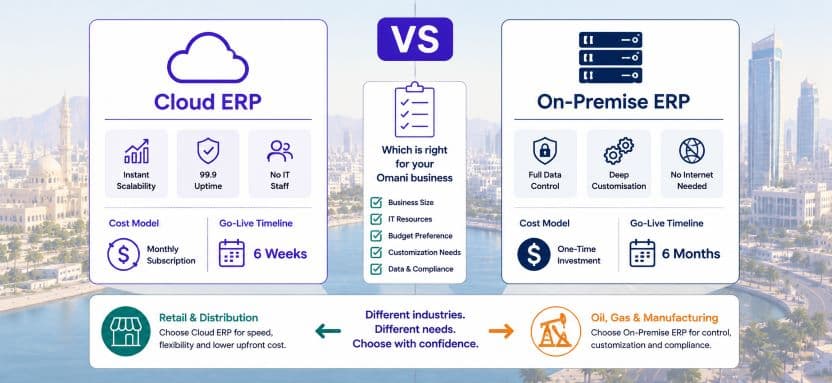
Cloud ERP vs On-Premise ERP: Master the Right Deployment Choice for Your Business
Anonymous
Cloud ERP vs on-premise ERP is one of the most consequential technology decisions Omani business owners and IT managers face when evaluating ERP platforms in 2024. The choice is not simply about where the software runs. It determines your monthly operating cost, your data sovereignty, your disaster recovery capability, your IT staffing requirement, and how quickly you can scale as your business grows. As Oman’s Information Technology Authority continues to push cloud adoption across the public and private sectors under Vision 2040, the pressure to make an informed, future-proof ERP deployment decision has never been more urgent. This guide gives you a clear, Oman-specific comparison so your business can make the right call with confidence.
Why cloud ERP vs on-premise ERP matters more than the software itself
Most Omani businesses evaluating ERPNext, SAP, or any other ERP platform spend the majority of their time comparing features and pricing. Far fewer give equal attention to deployment architecture, even though the deployment model often has a greater long-term impact on total cost of ownership, system reliability, and business agility than the software features themselves. A misconfigured on-premise deployment for a business that lacks in-house IT capacity can cost three to five times more to maintain than its cloud equivalent. A cloud deployment for a business with strict data residency requirements can create compliance problems that outweigh all the operational benefits.
Cloud ERP vs on-premise Oman decisions require a framework specific to the Sultanate’s infrastructure, regulatory environment, and business operating conditions. That is exactly what this guide provides.
Cloud ERP vs on-premise ERP: direct comparison across nine decision factors
| Decision Factor | Cloud ERP | On-Premise ERP |
| Upfront capital cost | Low, subscription based | High, server and licence investment |
| Monthly operating cost | Predictable per-user fee | Variable, IT staff and maintenance |
| Implementation speed | 4 to 10 weeks typical | 3 to 9 months typical |
| IT staff requirement | None to minimal | Dedicated server and DBA staff |
| Data location | Hosted data centre, usually outside Oman | On your premises in Oman |
| Customisation depth | Moderate, cloud-constrained | Full access to codebase |
| Disaster recovery | Built-in, provider-managed | Manual setup, your responsibility |
| Scalability | Instantly add users or capacity online | Hardware upgrade required |
| Internet dependency | High, reliable connection required | Low operates on the local network |
The case for cloud ERP for Omani businesses
Lower upfront cost and predictable monthly spend
The most compelling argument for cloud ERP in the Omani SME context is the absence of capital expenditure. An on-premise ERPNext or SAP deployment requires purchasing servers, networking hardware, operating system licences, backup systems, and UPS power protection before a single user logs in. This upfront investment typically ranges from OMR 5,000 to OMR 40,000, depending on company size and chosen software. Cloud ERP eliminates this entirely. Omani businesses pay a monthly subscription per user, converting a large capital commitment into a predictable operating expense that scales with headcount. For SMEs managing cash flow carefully, this distinction alone often determines the deployment choice.
No IT infrastructure management burden
Cloud ERP vs on-premise ERP in Oman comparisons consistently reveal that the hidden cost of on-premise deployment is the ongoing IT management burden. Server patching, database backups, security updates, hardware failures, and capacity upgrades all require either dedicated in-house IT staff or expensive external support contracts. Most Omani SMEs do not have an IT department capable of managing an on-premise ERP server reliably. Cloud ERP shifts this responsibility entirely to the hosting provider. Your team logs in through a browser, and every infrastructure concern is managed by specialists whose entire business is keeping your system running.
Built-in disaster recovery and 99.9% uptime guarantees
Oman is not immune to power disruptions, network outages, or hardware failures. An on-premise ERP server without a robust backup and recovery plan represents a single point of failure that can take a business offline for hours or days. Cloud ERP providers operate redundant data centres with automatic failover, daily backups, and contractual uptime guarantees that no Omani SME could afford to replicate with on-premise infrastructure. For businesses whose operations depend on continuous ERP access, this reliability advantage is often decisive.
Advantage of Cloud ERP: Omani businesses moving from on-premise or manual systems to cloud ERPNext report an average reduction of 35% in total technology operating costs within the first year, driven primarily by the elimination of server maintenance, IT support callouts, and hardware refresh cycles.
Automatic upgrades and feature releases
With cloud ERP, every software update, security patch, and new feature release is applied by the provider without any action required from your team. On-premise ERPNext deployments require your IT team or implementation partner to manage upgrades manually, which often means businesses fall behind on versions, miss critical security patches, and pay significant professional services fees for each major version upgrade. Cloud ERP vs on-premise ERP in Oman decisions frequently tip toward cloud on this factor alone for businesses that have experienced the disruption of a delayed on-premise upgrade cycle.
The case for on-premise ERP for Omani businesses
Full data sovereignty and residency control
The most significant advantage of on-premise ERP for Omani businesses is complete control over where data resides. For companies in sectors with data sensitivity requirements, including oil and gas operators, government-adjacent contractors, defence supply chain businesses, and healthcare providers, keeping all business data within their own facilities in Oman removes a category of regulatory and contractual risk that cloud hosting cannot fully address. Cloud ERP vs on-premise ERP Oman decisions in these sectors frequently favour on-premise, specifically because the client contract or regulatory framework requires it.
Deep customisation without cloud constraints
ERPNext is open source, meaning the entire codebase is accessible for modification. On-premise deployments allow Omani businesses to customise the system to a depth that cloud-hosted versions restrict. Custom modules, integrations with legacy systems, bespoke industry-specific workflows, and direct database-level modifications are all possible on-premise in ways that cloud deployment policies do not permit. For Omani manufacturers, oilfield services companies, and construction businesses with highly specific operational workflows, this customisation depth can be a decisive factor.
No internet dependency for operational continuity
Cloud ERP requires a reliable, consistent internet connection at every location where the system is accessed. For Omani businesses operating field sites in remote desert locations, offshore facilities, or industrial zones with variable connectivity, cloud ERP introduces an operational dependency that on-premise deployment eliminates. An on-premise server operating on the local area network functions regardless of internet availability, ensuring production records, inventory transactions, and payroll processing continue uninterrupted even during connectivity disruptions.
Omani businesses with remote field operations in Dhofar, the Rub al Khali, or offshore platforms should evaluate hybrid deployment models where a cloud instance handles head office functions and a local on-premise node handles field operations, synchronising when connectivity is available.
Cloud ERP vs on-premise ERP: which industries lean which way
| Industry Sector | Recommended Deployment | Primary Reason |
| Retail and trading SMEs | Cloud | Low IT overhead, fast go-live, scalable |
| Construction contractors | Cloud or hybrid | Multi-site access, mobile approvals |
| Healthcare clinics | Cloud | No IT staff, predictable cost |
| Oil and gas services | On-premise or hybrid | Data sensitivity, remote site connectivity |
| Government-adjacent contractors | On-premise | Data residency requirements |
| Manufacturing, small to mid | Cloud | Automatic updates, no server cost |
| Manufacturing, large and complex | On-premise or hybrid | Deep customisation, MES integration |
| Professional services | Cloud | Minimal infrastructure, fast deployment |
| Financial services | On-premise | Regulatory data control requirements |
ERPNext: the only Oman ERP platform that supports both deployments equally
Most enterprise ERP vendors push Omani businesses toward their cloud offering because it generates recurring revenue and reduces their support complexity. ERPNext is different. As an open-source platform, ERPNext supports cloud deployment through Frappe Cloud and other hosting providers, and on-premise deployment on your own servers, with identical functionality in both environments. There is no feature penalty for choosing on-premise, no cloud-only module that forces migration, and no vendor lock-in regardless of which deployment model you select.
Cloud ERP vs on-premise ERP decisions made with ERPNext are therefore genuinely about what works best for your business, not about what the software vendor prefers to sell you. For a complete overview of ERPNext deployment options and implementation approaches for Omani businesses, visit our ERPNext implementation tips for Omani businesses.
Cloud ERP vs on-premise ERP: a decision checklist for Omani business owners
Answer these eight questions to identify which deployment model fits your business:
- Does your business have dedicated IT staff capable of managing a Linux server and database backups? If no, lean cloud.
- Do your client contracts or industry regulations require data to remain physically within your Oman premises? If yes, lean on-premise.
- Does your business operate in locations with unreliable internet connectivity? If yes, consider on-premise or hybrid.
- Is your ERP budget structured as capital expenditure or operating expenditure? Capital favours on-premise, operating favours cloud.
- Do you need deep system customisation beyond standard ERPNext configuration? If yes, on-premises gives more flexibility.
- Is fast implementation a priority? Cloud deployments go live significantly faster than on-premise equivalents.
- Do you need to add users or locations quickly as you grow? Cloud scales instantly; on-premise requires hardware planning.
- Is disaster recovery and business continuity a top concern with limited internal IT resources? Cloud provides this out of the box.
Most Omani SMEs with fewer than 100 employees and no specific data residency obligations will find that cloud ERPNext delivers faster implementation, lower total cost, and less ongoing management burden than any on-premise alternative. The exception is almost always connectivity or data sensitivity, not preference.
Master cloud ERP vs on-premise ERP in Oman with a clear framework
Cloud ERP vs on-premise ERP in Oman is not a question with a universal answer, but it is a question with a logical framework. Cloud deployment wins on cost, speed, reliability, and scalability for the majority of Omani SMEs. On-premise deployment wins on data sovereignty, customisation depth, and operational independence from internet connectivity for businesses in specific industries or operating environments. ERPNext delivers identical capability in both models, meaning the decision is entirely driven by your business needs and not by software vendor preference.
The worst outcome is delaying the ERP decision because the deployment question feels unresolved. Choose the model that fits your current constraints, implement ERPNext, and review the deployment architecture in twelve months when you have real operational data to inform any change.
Contact Gazelle today for a free cloud versus on-premise assessment tailored to your Omani business size, industry, connectivity environment, and data requirements.